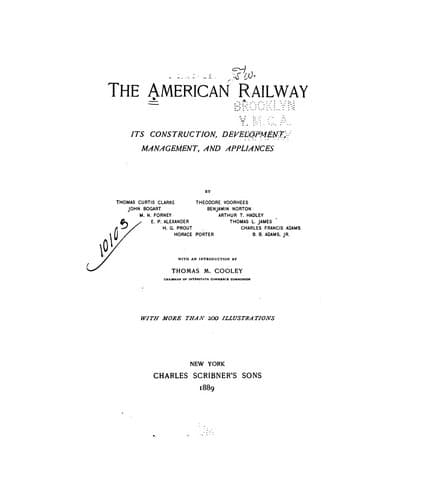
The American Railway: Its Construction, Development, Management, and AppliancesClarke, Thomas Curtis
History
The American Railway: Its Construction, Development, Management, and Appliances
Clarke, Thomas Curtis
Railroads -- United States
P. S. Parties desiring to engage a car for the day can be
accommodated after July 5th.
It will be seen that the word train was not used, but instead the
schedule spoke of a "brigade of cars."
The South Carolina Railroad was begun about the same time as the
Baltimore & Ohio, and ran from Charleston to Hamburg, opposite
Augusta. When the first division had been constructed, it was
opened November 2, 1830.
Peter Cooper, of New York, had before this constructed a locomotive
and made a trial trip with it on the Baltimore & Ohio Railroad, on
the 28th of August, 1830, but, not meeting the requirements of the
company, it was not put into service.
[Illustration: Mohawk & Hudson Train.]
A passenger train of the Mohawk & Hudson Railroad which was put
on in October, 1831, between Albany and Schenectady, attracted
much attention. It was hauled by an English engine named the "John
Bull," and driven by an English engineer named John Hampson. This
is generally regarded as the first fully equipped passenger train
hauled by a steam-power engine which ran in regular service in
America. During 1832 it carried an average of 387 passengers daily.
The accompanying engraving is from a sketch made at the time.
It was said by an advocate of mechanical evolution that the
modern steam fire-engine was evolved from the ancient leathern
fire-bucket; it might be said with greater truth that the modern
railway car has been evolved from the old-fashioned English
stage-coach.
England still retains the railway carriage divided into
compartments, that bear a close resemblance inside and outside
to stage-coach bodies with the middle seat omitted. In fact,
the nomenclature of the stage-coach is in large measure still
preserved in England. The engineer is called the driver, the
conductor the guard, the ticket-office is the booking-office, the
cars are the carriages, and a rustic traveller may still be heard
occasionally to object to sitting with his back to the horses. The
earlier locomotives, like horses, were given proper names, such
as Lion, North Star, Fiery, and Rocket; the compartments in the
round-houses for sheltering locomotives are termed the stalls, and
the keeper of the round-house is called the hostler. The last two
are the only items of equine classification which the American
railway system has permanently adopted.
[Illustration: English Railway Carriage, Midland Road. First and
Third Class and Luggage Compartments.]
America, at an early day, departed not only from the nomenclature
of the turnpike, but from the stage-coach architecture, and adopted
a long car in one compartment and containing a middle aisle which
admitted of communication throughout the train. The car was carried
on two trucks, or bogies, and was well adapted to the sharp
curvature which prevailed upon our railways.
Public-domain text, read in full here on John Shaqi.
Reviews
Reviews
No reviews yet
Be the first to share your thoughts on this work.
Elsewhere in the archive
Join the Discussion
Join the discussion
Sign in to leave a comment or review.
Sign InorCreate an account