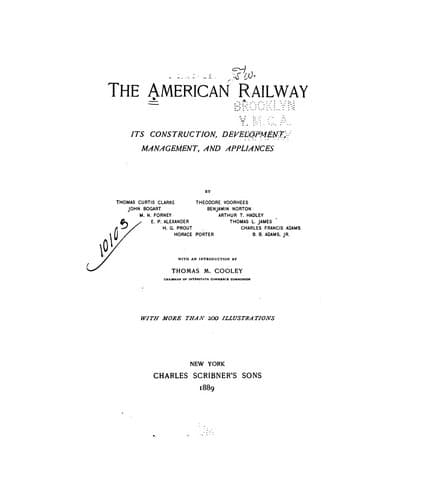
The American Railway: Its Construction, Development, Management, and AppliancesClarke, Thomas Curtis
History
The American Railway: Its Construction, Development, Management, and Appliances
Clarke, Thomas Curtis
Railroads -- United States
The first five years of experience showed marked progress in the
practical operation of railway trains, but even after locomotives
had demonstrated their capabilities and each improved engine had
shown an encouraging increase in velocity, the wildest flights of
fancy never pictured the speed attained in later years.
[Illustration: One of the Earliest Passenger Cars Built in this
Country; used on the Western Railroad of Massachusetts (now the
Boston & Albany).]
When the roads forming the line between Philadelphia and
Harrisburg, Pa., were chartered in 1835, and town meetings were
held to discuss their practicability, the Honorable Simon Cameron,
while making a speech in advocacy of the measure, was so far
carried away by his enthusiasm as to make the rash prediction that
there were persons within the sound of his voice who would live to
see a passenger take his breakfast in Harrisburg and his supper in
Philadelphia on the same day. A friend of his on the platform said
to him after he had finished: "That's all very well, Simon, to tell
to the boys, but you and I are no such infernal fools as to believe
it." They both lived to travel the distance in a little over two
hours.
[Illustration: Bogie Truck.]
The people were far from being unanimous in their advocacy of the
railway system, and charters were not obtained without severe
struggles. The topic was the universal subject of discussion in
all popular assemblages. Colonel Blank, a well-known politician
in Pennsylvania, had been loud in his opposition to the new means
of transportation. When one of the first trains was running over
the Harrisburg & Lancaster road, a famous Durham bull belonging
to a Mr. Schultz became seized with the enterprising spirit of
Don Quixote, put his head down and tail up, and made a desperate
charge at the on-coming locomotive, but his steam-breathing
opponent proved the better butter of the two and the bull was
ignominiously defeated. At a public banquet held soon after in that
part of the State, the toast-master proposed a toast to "Colonel
Blank and Schultz's bull--both opposed to railroad trains." The
joke was widely circulated and had much to do with completing the
discomfiture of the opposition in the following elections.
[Illustration: Rail and Coach Travel in the White Mountains.]
Public-domain text, read in full here on John Shaqi.
Reviews
Reviews
No reviews yet
Be the first to share your thoughts on this work.
Elsewhere in the archive
Join the Discussion
Join the discussion
Sign in to leave a comment or review.
Sign InorCreate an account