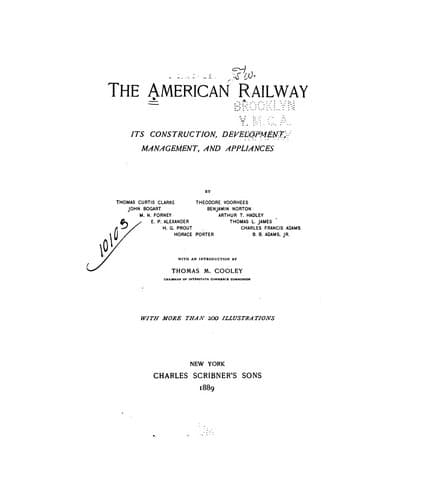
The American Railway: Its Construction, Development, Management, and AppliancesClarke, Thomas Curtis
History
The American Railway: Its Construction, Development, Management, and Appliances
Clarke, Thomas Curtis
Railroads -- United States
The introduction of the bell-cord running through the train and
enabling conductors to communicate promptly by means of it with
the engineer, and signal him in case of danger, constitutes
another source of safety, but is still a wonder to Europeans, who
cannot understand why passengers do not tamper with it, and how
they can resist the temptation to give false signals by means of
it. The only answer is that our people are educated up to it,
and being accustomed to govern themselves, they do not require
any restraint to make them respect so useful a device. Aside
from the inconveniences which used to arise occasionally from a
rustic mistaking the bell-cord for a clothes-rack, and hanging his
overcoat over it, or from an old gentleman grabbing hold of it to
help him climb into an upper berth in a sleeping-car, it has been
singularly exempt from efforts to pervert it to unintended uses.
The application of the magnetic telegraph to railways wrought
the first great revolution in despatching trains, and introduced
an element of promptness and safety in their operation of which
the most sanguine of railroad advocates had never dreamed. The
application of electricity was gradually availed of in many
ingenious signal devices for both day and night service, to direct
the locomotive engineer in running his train, and interpose
precautions against accidents. Fusees have also been called into
requisition, which burn with a bright flame a given length of
time; and when a train is behind time and followed by another, by
igniting one of these lights, and leaving it on the track, the
train following can tell by noting the time of burning about how
near it is the preceding train. Torpedoes left upon the track,
which explode when passed over by the wheels of a following train
and warn it of its proximity to a train ahead, are also used.
In the early days more accidents arose from switches than from any
other cause; but improvement in their construction has progressed
until it would seem that the dangers have been effectually
overcome. The split-rail switch prevents a train from being thrown
off the track in case the switch is left open, and the result is
that in such an event the train is only turned on another track.
The Wharton switch, which leaves the main line unbroken, marks
another step in the march of improvement. Among other devices is
a complete interlocking-switch system, by means of which one man
standing in a switch-tower, overlooking a large yard with numerous
tracks, over which trains arrive and depart every few minutes, can,
by moving a system of levers, open any required track and by the
same motion block all the others, and prevent the possibility of
collisions or other accidents resulting from trains entering upon
the wrong track.[25]
Public-domain text, read in full here on John Shaqi.
Reviews
Reviews
No reviews yet
Be the first to share your thoughts on this work.
Elsewhere in the archive
Join the Discussion
Join the discussion
Sign in to leave a comment or review.
Sign InorCreate an account