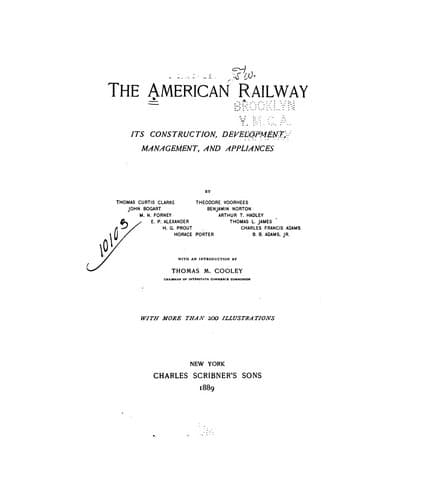
The American Railway: Its Construction, Development, Management, and AppliancesClarke, Thomas Curtis
History
The American Railway: Its Construction, Development, Management, and Appliances
Clarke, Thomas Curtis
Railroads -- United States
After the principal companies had sent agents to Europe to gather
all the information possible regarding the progress made there,
they soon began to aim at perfecting what may justly be called the
American system of railways. The roadbed, or what in England is
called the "permanent way," was constructed in such a manner as to
conform to the requirements of the new country, and the equipment
was adapted to the wants of the people. In no branch of industry
has the inventive genius of the race been more skilfully or more
successfully employed than in the effort to bring railway travel
to its present state of perfection. Every year has shown progress
in perfecting the comforts and safety of the railway car. In 1849
the Hodge hand-brake was introduced, and in 1851 the Stevens brake.
These enabled the cars to be controlled in a manner which added
much to the economy and safety of handling the trains. In 1869
George Westinghouse patented his air-brake, by which power from the
engine was transmitted by compressed air carried through hose and
acting upon the brakes of each car in the train.[23] It was under
the control of the engineer, and its action was so prompt and its
power so effectual that a train could be stopped in an incredibly
short time, and the brakes released in an instant. In 1871 the
vacuum-brake was devised, by means of which the power was applied
to the brakes by exhausting the air.
[Illustration: Obverse and Reverse of a Ticket Used in 1838, on the
New York & Harlem Railroad.]
A difficulty under which railways suffered for many years was
the method of coupling cars. The ordinary means consisted of
coupling-pins inserted into links attached to the cars. There was
a great deal of "slack," the jerking of the train in consequence
was very objectionable, and the distance between the platforms of
the cars made the crossing of them dangerous. In collisions one
platform was likely to rise above that of the adjoining car, and
"telescoping" was not an uncommon occurrence.
The means of warning passengers against standing on the platform
were characteristic of the dangers which threatened, and were often
ingenious in the devices for attracting attention. On a New Jersey
road there was painted on the car-door a picture of a new-made
grave, with a formidable tombstone, on which was an inscription
announcing to a terrified public that it was "Sacred to the memory
of the man who had stood on a platform."
The Miller coupler and buffer was patented in 1863, and obviated
many of the discomforts and dangers arising from the old methods of
coupling. This was followed by the Janney coupler[24] and a number
of other devices, the essential principle of all being an automatic
arrangement by which the two knuckles of the coupler when thrust
together become securely locked, and a system of springs which keep
the buffers in close contact and prevent jerking and jarring when
the train is in motion.
Public-domain text, read in full here on John Shaqi.
Reviews
Reviews
No reviews yet
Be the first to share your thoughts on this work.
Elsewhere in the archive
Join the Discussion
Join the discussion
Sign in to leave a comment or review.
Sign InorCreate an account