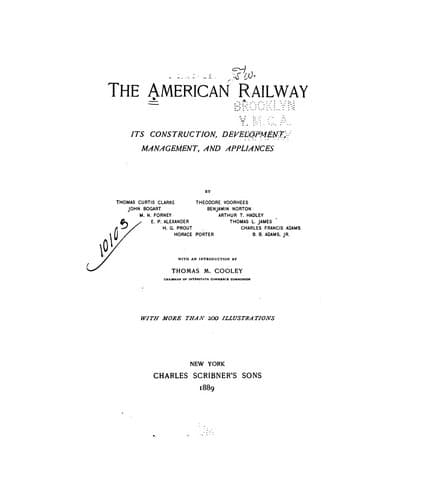
The American Railway: Its Construction, Development, Management, and AppliancesClarke, Thomas Curtis
History
The American Railway: Its Construction, Development, Management, and Appliances
Clarke, Thomas Curtis
Railroads -- United States
In 1864 Mr. Pullman perfected his plans for a car which was to be
a marked and radical departure from any one ever before attempted,
and that year invested his capital in the construction of what may
be called the father of the Pullman cars. He built it in a shed
in the yard of the Chicago & Alton Railroad at a cost of $18,000,
named it the "Pioneer," and designated it by the letter "A." It
did not then occur to anyone that there would ever be enough
sleeping-cars introduced to exhaust the whole twenty-six letters of
the alphabet. The sum expended upon it was naturally looked upon
as fabulous at a time when such sleeping-cars as were used could
be built for about $4,500. The constructor of the "Pioneer" aimed
to produce a car which would prove acceptable in every respect to
the travelling public. It had improved trucks and a raised deck,
and was built a foot wider and two and a half feet higher than any
car then in service. He deemed this necessary for the purpose of
introducing a hinged upper berth, which, when fastened up, formed a
recess behind it for stowing the necessary bedding in the daytime.
Before that the mattresses had been piled in one end of the car,
and had to be dragged through the aisle when wanted. It was known
to him that the dimensions of the bridges and station-platforms
would not admit of its passing over the line, but he was singularly
confident in the belief that an attractive car, constructed upon
correct principles, would find its way into service against all
obstacles. It so happened that soon after the car was finished,
in the spring of 1865, the body of President Lincoln arrived
at Chicago, and the "Pioneer" was wanted for the funeral train
which was to take it to Springfield. To enable the car to pass
over the road, the station-platforms and other obstructions were
reduced in size, and thereafter the line was in a condition to put
the car into service. A few months afterward General Grant was
making a trip West to visit his home in Galena, Ill., and as the
railway companies were anxious to take him from Detroit to his
destination in the car which had now become quite celebrated, the
station-platforms along the line were widened for the purpose, and
thus another route was opened to its passage.
The car was now put into regular service on the Alton road. Its
popularity fully realized the anticipations of its owner, and its
size became the standard for the future Pullman cars as to height
and width, though they have since been increased in length.
The railroad company entered into an agreement to have this car,
and a number of others which were immediately built, operated upon
its lines. They were marvels of beauty, and their construction
embraced patents of such ingenuity and originality that they
attracted marked attention in the railroad world and created a new
departure in the method of travel.
Public-domain text, read in full here on John Shaqi.
Reviews
Reviews
No reviews yet
Be the first to share your thoughts on this work.
Elsewhere in the archive
Join the Discussion
Join the discussion
Sign in to leave a comment or review.
Sign InorCreate an account