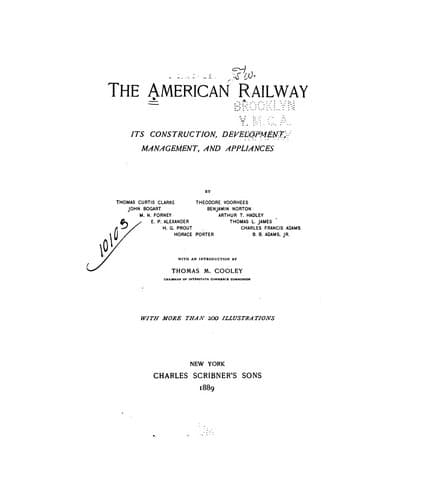
The American Railway: Its Construction, Development, Management, and AppliancesClarke, Thomas Curtis
History
The American Railway: Its Construction, Development, Management, and Appliances
Clarke, Thomas Curtis
Railroads -- United States
In 1867 Mr. Pullman formed the Pullman Car Company and devoted
it to carrying out an idea which he had conceived, of organizing
a system by which passengers could be carried in luxurious cars
of uniform pattern, adequate to the wants of both night and day
travel, which would run through without change between far-distant
points and over a number of distinct lines of railway, in charge of
responsible through agents, to whom ladies, children, and invalids
could be safely intrusted. This system was especially adapted to
a country of such geographical extent as America. It supplied an
important want, and the travelling public and the railways were
prompt to avail themselves of its advantages.
Parlor or drawing-room cars were next introduced for day runs,
which added greatly to the luxury of travel, enabling passengers
to secure seats in advance, and enjoy many comforts which were
not found in ordinary cars. Sleeping and parlor cars were soon
recognized as an essential part of a railway's equipment and became
known as "palace cars."
The Wagner Car Company was organized in the State of New York, and
was early in the field in furnishing this class of vehicles. It has
supplied all the cars of this kind used upon the Vanderbilt system
of railways and a number of its connecting roads. Several smaller
palace-car companies have also engaged in the business at different
times. A few roads have operated their own cars of this class, but
the business is generally regarded as a specialty, and the railway
companies recognize the advantages and conveniences resulting from
the ability of a large car-company to meet the irregularities
of travel, which require a large equipment at one season and a
small one at another, to furnish an additional supply of cars for
a sudden demand, and to perform satisfactorily the business of
operating through cars in lines composed of many different railways.
[Illustration: Pullman Parlor Car.]
Next came a demand for cars in which meals could be served. Why,
it was said, should a train stop at a station for meals any more
than a steam-boat tie up to a wharf for the same purpose? The
Pullman Company now introduced the hotel-car, which was practically
a sleeping-car with a kitchen and pantries in one end and portable
tables which could be placed between the seats of each section and
upon which meals could be conveniently served. The first hotel-car
was named the "President," and was put into service on the Great
Western Railway of Canada, in 1867, and soon after several popular
lines were equipped with this new addition to the luxuries of
travel.
[Illustration: Wagner Parlor Car.]
Public-domain text, read in full here on John Shaqi.
Reviews
Reviews
No reviews yet
Be the first to share your thoughts on this work.
Elsewhere in the archive
Join the Discussion
Join the discussion
Sign in to leave a comment or review.
Sign InorCreate an account