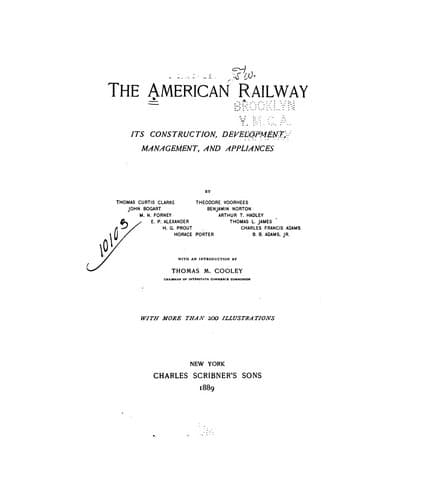
The American Railway: Its Construction, Development, Management, and AppliancesClarke, Thomas Curtis
History
The American Railway: Its Construction, Development, Management, and Appliances
Clarke, Thomas Curtis
Railroads -- United States
In the early period of railways in this country, when they were
built chiefly to promote local interests, and the movement
of either freight or passengers over long distances was a
comparatively small portion of the traffic, it was customary for
all roads to do their business in their own cars, transferring
any freight destined to a station on a connecting road at the
junction or point of interchange of the two roads. While this
system had the advantage of keeping at home the equipment of each
road, it resulted in a very slow movement of the freight. As the
volume of traffic grew, and the interchange of commodities between
distant points increased, this slow movement became more and
more vexatious. Soon the railway companies found it necessary to
allow their cars to run through to the destination of the freight
without transfer, or they would be deprived of the business by more
enterprising rivals. So that to-day a very large proportion of the
freight business of the country is done without transfer; the same
car taking the load from the initial point direct to destination.
The result of this is, however, that a considerable share of all
the business of any railway is done in cars belonging to other
companies, for which mileage has to be paid; while, in turn, the
cars of any one company may be scattered all over the country from
Maine to California, Winnipeg to Mexico.
The problem that constantly confronts the general superintendent of
a railway is, how to improve the time of through freight, thereby
improving the service and increasing the earnings of the company;
and, at the same time, how to secure the prompt movement of cars
belonging to the company, getting them home from other roads, and
reducing as far as possible upon his own line the use of foreign
cars, and the consequent payment of mileage therefor.
By common consent the mileage for the use of all eight-wheel
freight cars has been fixed at three-quarters of a cent per mile
run; four-wheel cars being rated at one-half this amount, or
three-eighths of a cent. This amount would at first sight appear
to be insignificant, yet in the aggregate it comes to a very
considerable sum. In the case of some of the more important roads
in the country, even those possessing a large equipment, the
balance against them for mileage alone often amounts to nearly half
a million annually.
It becomes therefore of the first importance to reduce to a minimum
the use of foreign cars, thereby reducing the mileage balance;
at the same time avoiding any action that will interfere with or
impede in any way the prompt movement of traffic.
Public-domain text, read in full here on John Shaqi.
Reviews
Reviews
No reviews yet
Be the first to share your thoughts on this work.
Elsewhere in the archive
Join the Discussion
Join the discussion
Sign in to leave a comment or review.
Sign InorCreate an account