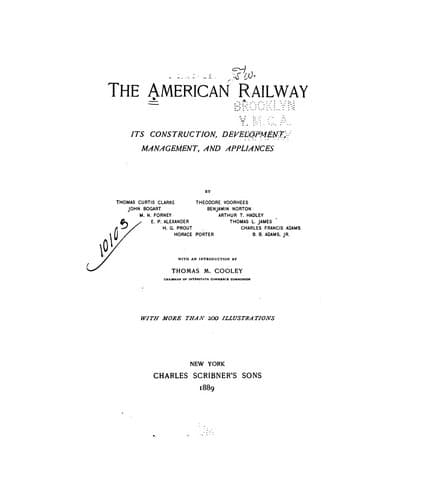
The American Railway: Its Construction, Development, Management, and AppliancesClarke, Thomas Curtis
History
The American Railway: Its Construction, Development, Management, and Appliances
Clarke, Thomas Curtis
Railroads -- United States
The first step toward accomplishing this result is to organize
and fully equip the Car Accountant's Department. The importance of
this office has been recognized only of late years. Formerly, and
on many lines even now, the Car Accountant was merely a subordinate
in the Auditing Department of the company. His duties were confined
strictly to computing the mileage due to other roads. This he
did from the reports of the freight-train conductors, often in a
cumbrous and mechanical manner, making no allowance for possible
errors. At the same time, he received reports of foreign roads
without question and without check. He was not interested in any
way in the operations of the Transportation Department; and, as a
consequence, it never occurred to him to make inquiries as to the
proper use of the cars belonging to his own company. That he left
entirely to the Superintendent. The latter, on the other hand, his
time incessantly filled with many duties, could give but scant
attention to his cars.
The Superintendent of a railway in this country who has, let us
say, three hundred miles of road in his charge, has perhaps as
great a variety of occupation, and as many different questions
of importance depending upon his decision, as any other business
or professional man in the community. Fully one-half of his time
will be spent out-of-doors looking after the physical condition
of his track, masonry, bridges, stations, buildings of all kinds.
Concerning the repair or renewal of each he will have to pass
judgment. He must know intimately every foot of his track and,
in cases of emergency or accident, know just what resources he
can depend upon, and how to make them most immediately useful.
He will visit the shops and round houses frequently, and will
know the construction and daily condition of every locomotive,
every passenger and baggage car. He will consult with his Master
Mechanic, and often will decide which car or engine shall and
which shall not be taken in for repair, etc. He has to plan and
organize the work of every yard, every station. He must know the
duties of each employee on his pay-rolls, and instruct all new men,
or see that they are properly instructed. He must keep incessant
and vigilant watch on the movement of all trains, noting the
slightest variation from the schedules which he has prepared, and
looking carefully into the causes therefor, so as to avoid its
recurrence. The first thing in the morning he is greeted with a
report giving the situation of business on the road, the events of
the night, movement of trains, and location and volume of freight
to be handled. The last thing at night he gets a final report of
the location and movement of important trains; and he never closes
his eyes without thinking that perhaps the telephone will ring and
call him before dawn. During the day in his office he has reports
to make out, requisitions to approve, a varied correspondence, not
always agreeable, to answer.
Public-domain text, read in full here on John Shaqi.
Reviews
Reviews
No reviews yet
Be the first to share your thoughts on this work.
Elsewhere in the archive
Join the Discussion
Join the discussion
Sign in to leave a comment or review.
Sign InorCreate an account