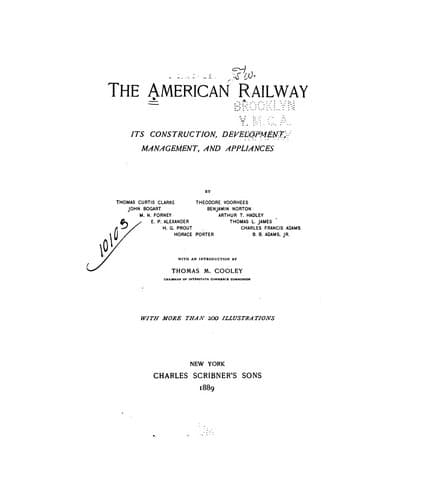
The American Railway: Its Construction, Development, Management, and AppliancesClarke, Thomas Curtis
History
The American Railway: Its Construction, Development, Management, and Appliances
Clarke, Thomas Curtis
Railroads -- United States
The shipper delivers the goods at the receiving freight-house
of the railway company. His cartman gets a receipt from the
tallyman. This receipt may be sent direct to the consignee, or
more frequently is exchanged for a bill of lading. There the
responsibility of the shipper ends. His goods are in the hands of
the railway company, which to all intents and purposes guarantees
their safe and prompt delivery to the consignee.
The tallyman's receipt is taken in duplicate. The latter is kept
in the freight-house until the freight is loaded in a car, and is
then marked with the initials and number of the car into which the
freight has been loaded. After that it is taken to the bill clerk
in the office, and from it and others is made the waybill or bills
for that particular car.
Where the volume of freight received at a given station is large,
it is customary to put all packages for a common destination, as
far as possible, in a car by themselves, thus making what are
termed "straight" cars. This is not always possible, however, or if
attempted would lead to loading a very large number of cars with
but light loads. So that it becomes necessary to group freight for
contiguous stations in one car, and again often to put freight for
widely distant cities in the same car. These latter are known as
"mixed" cars.
We will assume the day's receipt of freight finished, and most of
the cars loaded. About 6 P.M. the house will be "pulled," that
is, those cars already loaded will be taken away, and an empty
"string" of cars put in their place. An hour later, this "string"
will in turn be loaded and taken out, and the operation repeated,
until all the day's receipt of freight is loaded. Meanwhile other
freight will have been loaded direct from the shippers' carts on to
cars on the receiving tracks. For all cars, there is made out in
the freight-office a running slip or memorandum bill, which gives
simply the car number, initials, and destination. These are given
to the yardmaster or despatcher, and from them he "makes up" the
trains.
To a very great degree, the good movement of freight depends
upon the vigilance of the yardmasters and the care with which
they execute their duties. In an important terminal yard, the
yardmaster may have at all times from one to two thousand cars,
loaded and empty. He must know what each car contains, what is its
destination, and on what track it is. To enable him to do this,
he has one or more assistants, day and night. They, in turn, will
have foremen in charge of yard crews, each of the latter having
immediate charge of one engine. The number of engines employed will
vary constantly with the volume of the freight handled, but it
is safe to assume that there will be at all times nearly as many
engines employed in shifting in the various yards and important
stations on a line as there are road engines used in the movement
of the freight traffic.
Public-domain text, read in full here on John Shaqi.
Reviews
Reviews
No reviews yet
Be the first to share your thoughts on this work.
Elsewhere in the archive
Join the Discussion
Join the discussion
Sign in to leave a comment or review.
Sign InorCreate an account