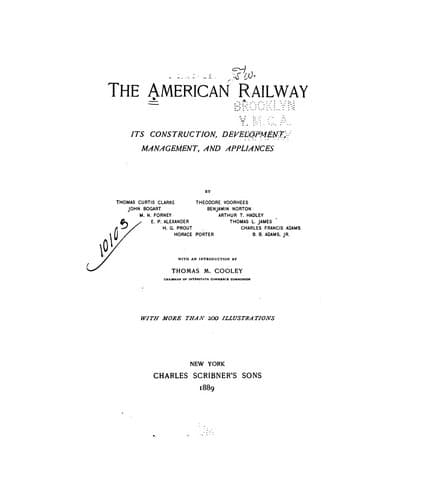
The American Railway: Its Construction, Development, Management, and AppliancesClarke, Thomas Curtis
History
The American Railway: Its Construction, Development, Management, and Appliances
Clarke, Thomas Curtis
Railroads -- United States
The work of the yard goes on without intermission day and night,
Sundays as well as week-days. The men there employed know no
holidays, get no vacations. The loaded cars are coming from the
freight-houses all day long, in greater numbers perhaps in the
afternoon and evening, but the work of loading and moving cars
goes on somewhere or other, at nearly all times. As often as the
yardmaster gets together a sufficient number of cars for a common
destination to make up a train, he gathers them together, orders a
road engine and crew to be ready, and despatches them. In the make
up of "through" trains, care has to be exercised to put together
cars going to the same point, and to "group" the trains so that
as little shifting as possible may be required at any succeeding
yard or terminal, where the trains may pass. To accomplish this,
a thorough knowledge of all the various routes is necessary, and
minute acquaintance with the various intermediate junction yards
and stations.
The train once "made up" and in charge of the road crew, its
progress for the next few hours is comparatively simple. It will
go the length of the "run" at a rate of probably twenty miles per
hour, subject only to the ordinary vicissitudes of the road. At
the end of the division, if a through train, it will be promptly
transferred to another road crew with another engine, and so on.
Each conductor takes the running slip for each car in his train.
He also makes a report, giving the cars in his train by numbers
and initials, whether loaded or empty, how secured; and detailed
information in regard to any car out of order, or any slight mishap
or delay to his train. These reports go to the Car Accountant.
The running slips stay with the cars, being transferred from hand
to hand until the cars reach their destination. At junction yards
where one road terminates and connects with one or more foreign
roads, a complete record is kept, in a book prepared especially
for the purpose, of every car received from and delivered to each
connecting road. A copy of this information is sent daily to the
Car Accountant.
[Illustration: Freight Yards of the New York Central & Hudson River
Railroad, West Sixty-fifth Street, New York.]
[Illustration]
[Illustration: "Dummy" Train and Boy on Hudson Street, New York.]
A road is expected to receive back from a connecting line any car
that it has previously delivered loaded. It becomes very necessary
to know just what cars have been so delivered. Without such a
record a road is at the mercy of its connections, and may be forced
to receive and move over its length empty foreign cars that it
never had in its possession before, thus paying mileage and being
at the expense of moving cars that brought it no revenue whatever.
The junction records put a complete check on such errors, and by
their use thousands of dollars are saved annually.
* * * * *
Public-domain text, read in full here on John Shaqi.
Reviews
Reviews
No reviews yet
Be the first to share your thoughts on this work.
Elsewhere in the archive
Join the Discussion
Join the discussion
Sign in to leave a comment or review.
Sign InorCreate an account