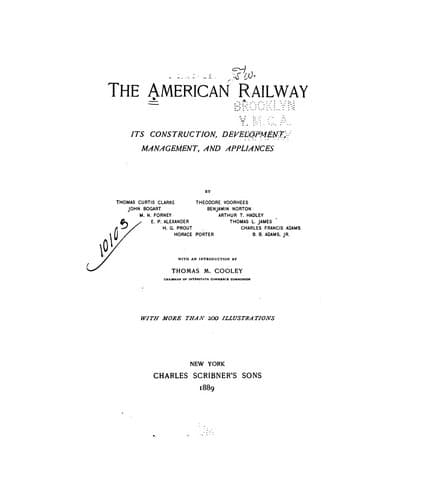
The American Railway: Its Construction, Development, Management, and AppliancesClarke, Thomas Curtis
History
The American Railway: Its Construction, Development, Management, and Appliances
Clarke, Thomas Curtis
Railroads -- United States
To still more expedite the movement of through freight, very
many so-called fast freight lines exist in this country, as, for
example, the Traders' Despatch, the Star Union, the Merchants'
Despatch Transportation Company, the Red, the White, the Blue, the
National Despatch, etc. Some of these lines are simply co-operative
lines, owned by the various railway companies whose roads are
operated in connection with one another. Their organization is
simple. A number of companies organize a line, which they put in
charge of a general manager. Each company will assign to the line a
number of cars, the quota of each being in proportion to its miles
of road. The general manager has control of the line cars. He has
agents who solicit business and employees who watch the movement
of his line cars, and report the same to him. He keeps close
record of his business, and reports promptly to the transportation
officer of any road in his line any neglect or delinquency he may
discover. The earnings of the line and its expenses are all divided
_pro rata_ among the roads interested. Such a line is simply an
organization to insure prompt service and secure competitive
business, and the entire benefit goes to the railway companies.
[Illustration: (Logo on a box-car)]
Other lines are in the nature of corporations, being owned by
stockholders and operating on a system of roads in accordance with
some agreement or contract. Others, again, are organized for some
special freight, and are owned wholly by firms or individuals, such
as the various dressed-beef lines and some lines of live-stock
cars. These are put in service simply for the mileage received for
their use, and in many cases the railway companies have no interest
in them whatever.
The movement of "straight" cars and "solid" trains is comparatively
simple. But there is a very large amount of through freight,
particularly of merchandise, that cannot be put into a "straight"
car. A shipper in New York can depend on his goods going in a
straight car to St. Louis, Denver, St. Paul, etc., but he can
hardly expect a straight car to any one of hundreds of intermediate
cities and towns. Still less is it possible for a road at a small
country-town, where there are perhaps but one or two factories, to
load straight cars to any but a very few places. To overcome this
difficulty, transfer freight-houses have to be provided. These are
usually located at important terminal stations.
[Illustration: Coal Car, Central Railroad of New Jersey.]
To them are billed all mixed cars containing through freight. These
cars are unloaded and reloaded, and out of a hundred "mixed" cars
will be made probably eighty straight and the balance local. This
necessarily causes some delay, but it is practically a gain in time
in the end, as otherwise every car would have to be reloaded, and
held at every station for which it contained freight.
[Illustration: (Logo on a box-car)]
Public-domain text, read in full here on John Shaqi.
Reviews
Reviews
No reviews yet
Be the first to share your thoughts on this work.
Elsewhere in the archive
Join the Discussion
Join the discussion
Sign in to leave a comment or review.
Sign InorCreate an account