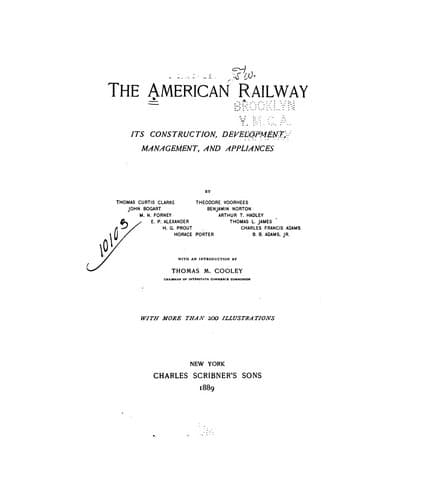
The American Railway: Its Construction, Development, Management, and AppliancesClarke, Thomas Curtis
History
The American Railway: Its Construction, Development, Management, and Appliances
Clarke, Thomas Curtis
Railroads -- United States
As an instance, the Long Island Railroad Company makes a specialty
of transporting farmers' truck-wagons to market. For this purpose
they have provided long, low, flat cars, each capable of carrying
four truck-wagons. The horses are carried in box-cars, and one
farmer or driver is carried with each team, a coach being provided
for their use. During the fall of the year, they frequently carry
from 45 to 50 wagons on one train, charging a small sum for each
wagon, and nothing for the horses or men. These trains run three
times weekly, and are arranged so as to arrive in the city about
midnight, returning the next day at noon. The trains by themselves
are not very remunerative, but by furnishing this accommodation,
farmers who are thirty or forty miles out on Long Island can have
just as good an opportunity for market-gardening as those who live
within driving distance of the city. This builds up the country
farther out on the island, which in turn gives the road other
business.
* * * * *
The movement of freight is not always successfully accomplished. In
spite of good organization, every facility, incessant watchfulness,
accidents will occur, freight will be delayed, cars will break
down, trains will meet with disaster. The consequences sometimes
fall heavily on the railway companies. The loss is frequently out
of all proportion to the revenue. The following instance is from
the writers own experience:
Some carpenters repairing a small low trestle left chips and
shavings near one of the bents. A passing train dropped some
ashes. The shavings caught fire and burnt one or two posts in one
bent. The section-men failed to notice the fire. Toward evening a
freight train came to the trestle, the burnt bent gave way, and
the train was derailed. Two men were killed, one severely injured,
and eighteen freight cars were burned. The resulting loss to the
railroad company was $56,113. Of this amount, the loss paid on
freight was $39,613.12. As a matter of interest, and to show the
disparity between the value of the commodities and the earnings
from freight charges received by the railway company, the amount of
each is given here in detail, taken from the actual records of the
case:
Public-domain text, read in full here on John Shaqi.
Reviews
Reviews
No reviews yet
Be the first to share your thoughts on this work.
Elsewhere in the archive
Join the Discussion
Join the discussion
Sign in to leave a comment or review.
Sign InorCreate an account