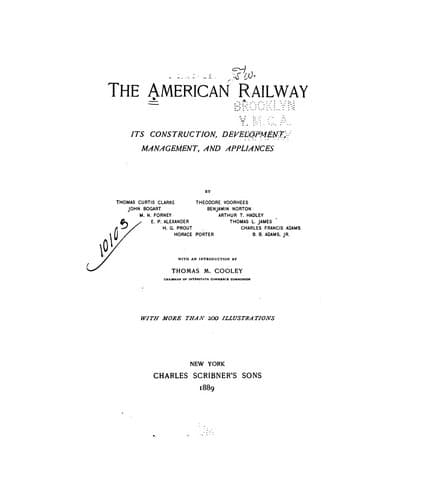
The American Railway: Its Construction, Development, Management, and AppliancesClarke, Thomas Curtis
History
The American Railway: Its Construction, Development, Management, and Appliances
Clarke, Thomas Curtis
Railroads -- United States
------------------------------+-----------------+------------------
Property destroyed. | Amount paid by |Freight charges on
|railroad company.| the same.
------------------------------+-----------------+------------------
Butter, 200 pounds at 35 cents| $70.00 | $0.50
Ore, 75.9 tons at $3.50 | 265.80 | 56.91
Paper, 4,600 pounds | 269.10 | 8.74
Pulp, 10,400 pounds | 160.00 | 12.65
Shingles, 85 M | 192.50 | 11.00
Horsenails | 2,986.06 | 37.44
Lumber | 252.00 | 18.40
Apples, 159 barrels | 508.80 | 15.26
Hops, 209 bales, 37,014 pounds| 34,908.86 | 59.22
------------------------------+-----------------+------------------
| $39,613.12 | $220.12
------------------------------+-----------------+------------------
This was during the fall of 1882, when hops sold in New York for
over $1 per pound.
The plan of payment for car service by the mile run,
without reference to time, has the merit of simplicity and
long-established usage. It is, however, in reality, crude and
unscientific, and has brought with it, in its train, numerous
disadvantages.
The owner of a car is entitled, first, to the proper interest
in his investment, that is, on the value of the car; second, to
a proper amount for wear and tear or for repairs. The life of a
freight car may be reasonably estimated at ten years, so that ten
per cent. on its value would be a fair interest-charge. The average
amount for repairs varies directly as to the distance the car
moves, and may be put at one-half cent per mile run.
It will be seen that by the ordinary method of payment the
car-owner is compensated for interest at the rate of ¼ of a cent
for the time that the car is in motion, but receives nothing for
all the time the car is at rest. If cars could be kept in motion
for any considerable portion of each twenty-four hours, this would
prove ample. But in practice it is found that few roads succeed
in getting an average movement of all cars for more than one
hour and a half in each twenty-four. This gives about five per
cent. interest on the value of the car, only one-half of what is
generally conceded to be a fair return. Still further, there is no
inducement to the road on which a foreign car is standing to hasten
its return home. On the contrary, there is a direct advantage in
holding the car idle until a proper load can be found for it,
rather than return it home empty. The most serious abuses of the
freight business of the country have grown from this state of
affairs. It costs nothing but the use of the track to hold freight
in cars; consequently freight is held in cars instead of being put
in storehouses, frequently for weeks and months at a time.
Public-domain text, read in full here on John Shaqi.
Reviews
Reviews
No reviews yet
Be the first to share your thoughts on this work.
Elsewhere in the archive
Join the Discussion
Join the discussion
Sign in to leave a comment or review.
Sign InorCreate an account