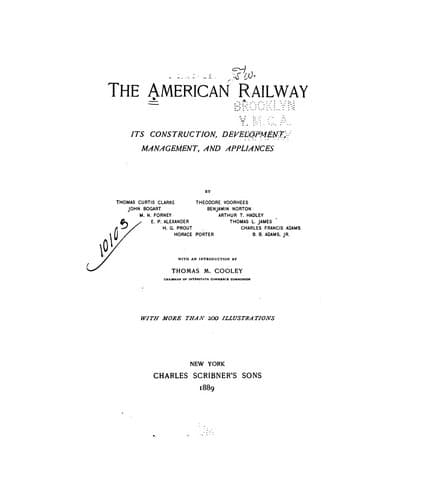
The American Railway: Its Construction, Development, Management, and AppliancesClarke, Thomas Curtis
History
The American Railway: Its Construction, Development, Management, and Appliances
Clarke, Thomas Curtis
Railroads -- United States
The sign (B) is used when a car is left at a station for repairs,
while in transit. The sign (T) denotes that the lading was
transferred to another car, a transfer record being kept showing
to what car transferred; the sign (R), when a car is on hand at a
station or yard for repairs. Shops are assigned numbers with an O
prefix; the upper and lower spaces being used to show delivery to,
or receipt from the shop, similar to the interchange record.
For convenience the twenty-four hour system is used for recording
time, and is shown in quarter-hours; thus, 10, 12^1, 18^2, 21^3,
representing 10 A.M., 12.15 P.M., 6.30 P.M., and 9.45 P.M. This,
used in the movement record, shows the running time on each
division, or detention at train terminals.
The "transfer" column shows the station at which the car was
reported on the last day of the previous month, and the _arriving
date_; also from what road received, with date.
HOW TO FEED A RAILWAY.
BY BENJAMIN NORTON.
The Many Necessities of a Modern Railway--The Purchasing and
Supply Departments--Comparison with the Commissary Department of
an Army--Financial Importance--Immense Expenditures--The General
Storehouse--Duties of the Purchasing Agent--The Best Material the
Cheapest--Profits from the Scrap-heap--Old Rails Worked over into
New Implements--Yearly Contracts for Staple Articles--Economy
in Fuel--Tests by the Best Engineers and Firemen--The
Stationery Supply--Aggregate Annual Cost of Envelopes, Tickets,
and Time-tables--The Average Life of Rails--Durability of
Cross-ties--What it Costs per Mile to Run an Engine--The
Paymaster's Duties--Scenes during the Trip of a Pay-car.
The commissary or supply department of a railroad is not unlike
that of a large army. Like a vast army, its necessities are many,
and the various departments which make up the whole system must be
provided with their necessary requirements in order to accomplish
the end for which it is operated.
If, again, we regard a railroad as a huge animal, the quantity
of supplies needed to fill its capacious maw is something
overwhelming. It is always hungry, and the daily bill of fare
(which includes pretty much everything known to trade) is gone
through with an appetite as vigorous and healthy at the end as
it exhibits in the beginning. Yet how few there are who realize
the important part this one feature plays in the operation of
the thousands of miles of railroad throughout the world! Upon
the proper conduct of this department depends very largely the
success of any road, so far as its relation to the stockholders
is concerned; for while, as has been the case in the past,
combinations and pools have aided in maintaining rates, and have
served to increase the income, and attention has been paid to
securing additional business in every possible way, the "out-goes"
have often been overlooked, to the detriment of dividends and the
general welfare of the property.
Public-domain text, read in full here on John Shaqi.
Reviews
Reviews
No reviews yet
Be the first to share your thoughts on this work.
Elsewhere in the archive
Join the Discussion
Join the discussion
Sign in to leave a comment or review.
Sign InorCreate an account