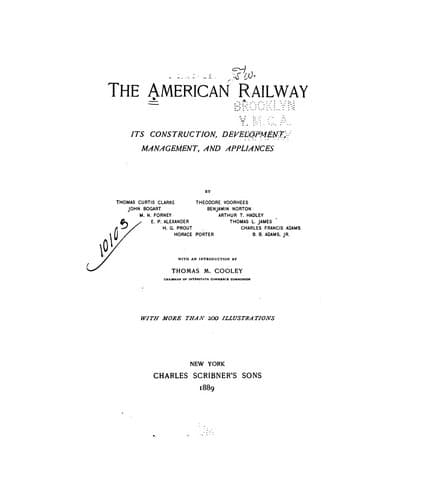
The American Railway: Its Construction, Development, Management, and AppliancesClarke, Thomas Curtis
History
The American Railway: Its Construction, Development, Management, and Appliances
Clarke, Thomas Curtis
Railroads -- United States
From cast-iron wheels and old rails, however, the
percentage is much larger, for while at present new passenger
car-wheels of this class, weighing about five hundred and fifty
pounds, are worth about ten dollars each, they will bring in the
market, when worn out after running say fifty thousand miles, about
twenty dollars per ton. Four wheels go to the ton, which represents
five dollars per wheel, or fifty per cent. of the original cost.
With old rails the percentage is even higher, in the present
condition of the rail market. Old iron rails are worth within four
or five dollars of the price of new steel, and the old steel about
seventy per cent. of the price of the new. These high percentages
assist in making up for the materials which are entirely consumed
in the service, and which never form a part of the ordinary
scrap-heap, such as oils, waste, and paints.
While the majority of general supplies just mentioned briefly may
be arranged for as required and purchased from month to month upon
regular requisitions, there are certain staple articles which are
provided for in advance by contract. Among them principally are
the engine-coal, rails and ties, stationery, passage-tickets, and
time-tables. More money is expended for such supplies than for any
others, and contracts with responsible business houses, for their
delivery at fixed prices for the limit of at least a year, are
generally made to insure, in the first place, the lowest market
rates and, again, to make the delivery certain.
Locomotive fuel is the largest single item of expense in the
operation of any road, the consumption of it running up as high as
a million tons per annum on some large roads; and while there are
a few exceptional cases where wood is used as fuel, coal is the
necessary element in nearly every case in America to-day.
Of the two general varieties--bituminous or soft, and anthracite
or hard--it is safe to say that bituminous coal is the more
economical, assuming that the grade employed is the best, this
economy lying both in the original cost and the fact that the bulk
of it goes to serve its purpose, there being comparatively little
waste in the way of ashes; while the anthracite produces many ashes
and clinkers, requires much more care and attention on the part of
the stoker or fireman, and costs, as a general rule, about thirty
per cent. more. Economy, however, should not be carried too far in
any branch of the service, and if the passenger traffic be heavy
the use of soft coal may be a great detriment. To a traveller
there can be nothing more disagreeable than the smoke and cinders
emanating from it; and if, besides this, the road be an especially
dusty one, the combination of dust, smoke, and cinders will be
quite sufficient to turn the tide of travel in some other direction
and over another route.
Public-domain text, read in full here on John Shaqi.
Reviews
Reviews
No reviews yet
Be the first to share your thoughts on this work.
Elsewhere in the archive
Join the Discussion
Join the discussion
Sign in to leave a comment or review.
Sign InorCreate an account