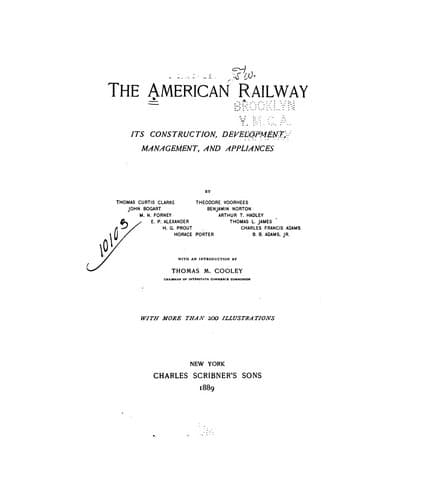
The American Railway: Its Construction, Development, Management, and AppliancesClarke, Thomas Curtis
History
The American Railway: Its Construction, Development, Management, and Appliances
Clarke, Thomas Curtis
Railroads -- United States
Lubricating and illuminating oils, paints and varnishes, soaps,
chalk, bunting, hardware, lamps, cotton and woollen waste, clocks,
brooms, and such metals as copper, pig tin, and antimony are only a
few of the many articles of diet which a railroad requires to keep
body and soul together, and give it strength to perform the great
duty it owes to commerce and the public. After they have all served
their purposes, such as cannot be worked over again in the shops,
and are not entirely consumed, are consigned to the scrap-heap
under the head of "old material"--an all-important consideration in
the economical management of any road. On many roads very little
attention is paid to the sale of scrap. As a general rule, the
purchasing agent has charge of it, and if he shows any shrewdness
in buying, he will exercise more or less ingenuity in selling. Most
railroad scrap has a fixed value in the market. Quotations for old
rails, car-wheels, and wrought iron are found in all the trade
journals; but as in buying one can usually buy of someone at prices
less than market price, so in selling he can often find a buyer who
is willing to pay more than the regular quotation. As it is found
not wise in the long run to purchase ahead on some prospective
rise, so in selling it is equally true that holding scrap over upon
the possibility of a rise in prices is not always for the best
advantage.
There has always been a demand for old iron rails, and recently
use for old steel rails has been found. They are worked over at
the rolling mills into crowbars and shovels, spikes, fish-plates,
bolts, and other necessary things to be employed in construction
and maintenance. Not long since an experiment with old steel rails
was successfully performed, whereby they were melted and poured
into moulds for use as brake-shoes. The result showed a casting
of unusual hardness which would outwear three ordinary cast-iron
shoes. This opens up an entirely new field in railroad economy,
for with ordinary foundry appliances accumulations of old steel
rails can be worked over and cast into all sorts of shapes and
patterns to better advantage than selling them at a nominal price
to outside buyers. While worn-out car-wheels will generally bring
more money from wheel manufacturers than they command in the open
market, it has not always been found the best policy to compel the
mill from which the new wheels are purchased to take too many of
them. It is apt to encourage the use of too much old material in
the manufacture of the new; and while the company may consider that
it is realizing much more money on sales of the old wheels than
the market price, it does not take into account the inferior stock
it is getting back, or the fact that possibly when the mileage
is reckoned the wheels have signally failed to run as long as
they ought. In the aggregate about ten per cent. of the original
cost of all supplies purchased is realized out of the sales of
old material.
Public-domain text, read in full here on John Shaqi.
Reviews
Reviews
No reviews yet
Be the first to share your thoughts on this work.
Elsewhere in the archive
Join the Discussion
Join the discussion
Sign in to leave a comment or review.
Sign InorCreate an account