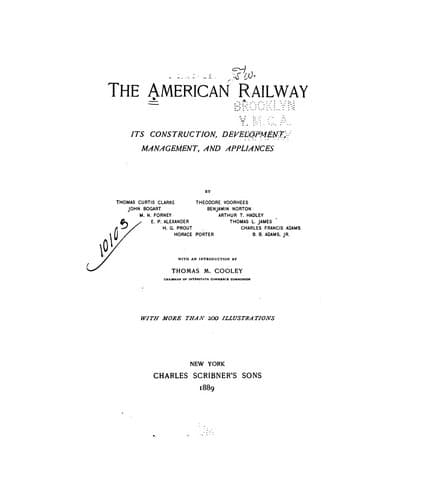
The American Railway: Its Construction, Development, Management, and AppliancesClarke, Thomas Curtis
History
The American Railway: Its Construction, Development, Management, and Appliances
Clarke, Thomas Curtis
Railroads -- United States
Fifteen thousand to twenty thousand dollars per annum for envelopes
alone is spent on some roads, and twice as much more perhaps for
time-tables.
Passage-tickets, including all varieties of regular and special
tickets, such as mileage books or coupons, family trip-books,
and school-tickets are also an item of large expense, the annual
consumption covering many tons, which once used are of no value
save as waste paper; yet they are absolutely indispensable in
the operation of the road. Yearly contracts for these are made,
and while the actual cost of a single ticket may not exceed _one
mill_, the aggregate on a road carrying fifteen millions to twenty
millions or more passengers per annum is considerable.
To induce the public to travel, and encourage shippers to send
their freight to market over any road, attention must first be paid
to the condition of the track and rolling stock.
It is not economy to allow anything to be out of repair, on
the supposition that it is less expensive than it would be to
spend comparatively little from day to day to keep it up. The
day of reckoning will come in the end, and the sacrifice will
be considerable. As the track is the fundamental feature, the
cross-ties or sleepers and rails should be the best. Iron rails are
practically out of date, and it is fair to assume that the time
is approaching when wooden ties will be things of the past. Where
the traffic is light, heavy steel rails may not be necessary; but
it has been generally found economical to put in use rails which
do not weigh less than sixty-seven or seventy pounds to the yard;
an even greater weight than this is not ill-advised--they require
fewer cross-ties to the mile, and in consequence the force of men
required to keep the track in condition is less. Light rails are
soon worn and battered out on a road over which heavy engines are
run and large trains are hauled. The powerful locomotives now built
require a well-kept track and a solid and substantial road-bed.
Heavier and faster trains have tended to reduce the average life of
rails, even though the weight of the rails has also been steadily
increasing. Circumstances vary on the different roads, but it is
safe to say that eight to ten per cent. of all rails in the track
must be renewed every year. This brings the average life of the
steel rails down to about twelve years, under ordinary conditions.
On some divisions, however, where the traffic is frequent, and in
yards where a good deal of switching is done, and the rails are
under pressure constantly, the average is, of course, very much
less--even as low as two or three years.
Public-domain text, read in full here on John Shaqi.
Reviews
Reviews
No reviews yet
Be the first to share your thoughts on this work.
Elsewhere in the archive
Join the Discussion
Join the discussion
Sign in to leave a comment or review.
Sign InorCreate an account