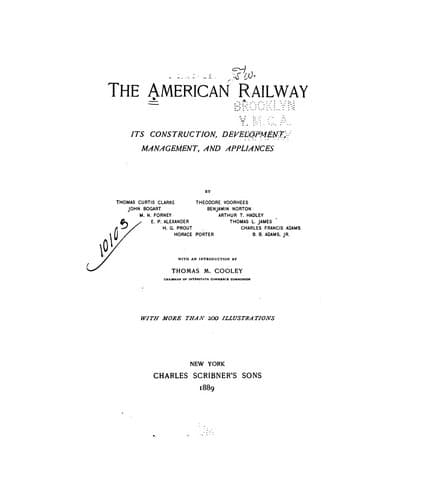
The American Railway: Its Construction, Development, Management, and AppliancesClarke, Thomas Curtis
History
The American Railway: Its Construction, Development, Management, and Appliances
Clarke, Thomas Curtis
Railroads -- United States
Aside from the durability of the timber employed, plenty of face
for the rail bearings, and uniform thickness and length, are
very important requirements in contracts for ties. While white
oak is generally considered the most durable for this purpose,
the growth of this timber is limited except in certain sections
of the country, so that cedar, cypress, chestnut, and yellow
pine are more commonly used than any other class. The millions
of them used for renewals and new roads each year are gradually
reducing our forests; and, like some of the European roads, we
shall some day fall back upon metal, which (while its life may not
be measured) will make so rigid a track that the traveller over
long distances will be worn out with his journey, and the rolling
stock will require frequent repairs and overhauling. The practice
of creosoting cross-ties is growing rapidly, and this tends to
increase their durability three or four times. While the first
cost of such ties may be double that for the unprepared timbers,
the result in the end is economical, for the labor alone required
to take out an old tie and put in a new one costs at least twelve
cents.
The general store-room is properly the intermediate stage, so far
as supplies are concerned, between the different departments of
the road and the Auditor, who charges up all material used to the
different accounts into which his system is divided. Properly,
everything in the nature of material, however small, directly or
indirectly passes through the Store-keeper's books. An account is
kept with each locomotive, station agent, switchman, and flagman,
so that to a penny everything consumed in the operation of a road
is accurately known. To accomplish this the Store-keeper, of
course, must be a good accountant, and at the same time be more
or less of an expert in railroad material. Under an economical
administration of his affairs he is able to save a great deal of
money for his company. By his system, with the aid of data from
the mechanical department, he can tell the average number of miles
run during the year to a pint of oil or a ton of coal; the number
of pounds of coal consumed per mile run, as well as the number of
pints of oil for the same distance. He can give in detail the cost
in cents per mile run for all the oil, tallow, and waste, fuel,
and other supplies consumed, and can account to a nicety for all
the lanterns, brooms, hardware, and other material which he has
received and distributed.
The following statement of averages represents fairly what it costs
to run a locomotive under ordinary conditions:
_Averages._
Number of miles run to pint of oil 15.32
Number of miles run to ton of coal 46.17
Number of pounds of coal per mile run 48.62
Number of pints of oil per mile run 0.06
_Cost in Cents per Mile Run._
Public-domain text, read in full here on John Shaqi.
Reviews
Reviews
No reviews yet
Be the first to share your thoughts on this work.
Elsewhere in the archive
Join the Discussion
Join the discussion
Sign in to leave a comment or review.
Sign InorCreate an account