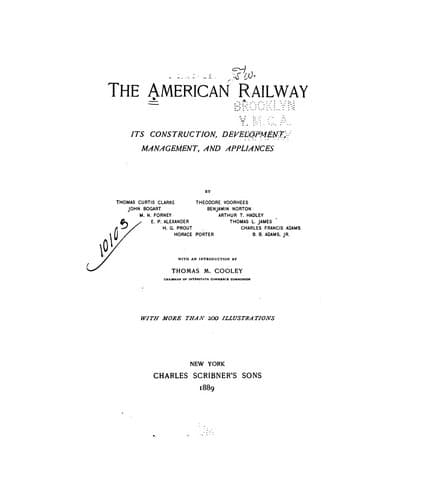
The American Railway: Its Construction, Development, Management, and AppliancesClarke, Thomas Curtis
History
The American Railway: Its Construction, Development, Management, and Appliances
Clarke, Thomas Curtis
Railroads -- United States
Later in the day it may be a shop gang of five hundred or one
thousand men, consisting of carpenters, painters, machinists,
and boiler-makers, and these are paid in order, each set of men
by itself. There is no noise or disturbance, everything goes
like clock-work, as all pass through in regular order, each gang
or class preceded by its foreman, and the men arranged in line
in the order in which their names appear on the pay-rolls. When
night comes, and two or three hundred miles of road have been
covered, the balance of the funds is carefully locked up in the
safe on board, the car run in upon some convenient siding, and
the engine housed for a wiping and a thorough preparation for the
next day's run. The car is generally provided with comfortable
beds for the Paymaster and his clerks, and during the paying-off
time they practically live in the car. This insures early starts
in the morning, and on large roads the necessity for haste is very
apparent, where possibly two or three weeks are consumed each month
in paying off the rolls.
* * * * *
The average traveller, spinning across the country at forty miles
an hour, is not apt to think of the countless details involved in
the make-up of the train in which he rides or the track over which
he is wheeled; but when he considers how safely the millions of
passengers are annually carried over the one hundred and fifty
thousand miles or more of railroad in this country alone, he may
be brought to realize that quite as much depends upon the quality
of the material entering into the construction of the train and
tracks as upon the efficiency of the engineer in the cab, or the
conductor, brakeman, switchmen, and train-despatcher who perform
their respective responsible duties in connection therewith.
Feeding a railroad, then, means a great deal more than the majority
of mankind supposes.
THE RAILWAY MAIL SERVICE.
BY THOMAS L. JAMES.
An Object Lesson in Postal Progress--Nearness of the Department
to the People--The First Travelling Post-Office in the United
States--Organization of the Department in 1789--Early Mail
Contracts--All Railroads made Post-routes--Compartments for
Mail Clerks in Baggage-cars--Origin of the Present System in
1862--Important Work of Colonel George S. Bangs--The "Fast Mail"
between New York and Chicago--Why it was Suspended--Resumption
in 1877--Present Condition of the Service--Statistics--A
Ride on the "Fast Mail"--Busy Scenes at the Grand Central
Depot--Special Uses of the Five Cars--Duties of the Clerks--How
the Work is Performed--Annual Appropriation for Special Mail
Facilities--Dangers Threatening the Railway Mail Clerk's Life--An
Insurance Fund Proposed--Needs of the Service--A Plea for Radical
Civil Service Reform.
Public-domain text, read in full here on John Shaqi.
Reviews
Reviews
No reviews yet
Be the first to share your thoughts on this work.
Elsewhere in the archive
Join the Discussion
Join the discussion
Sign in to leave a comment or review.
Sign InorCreate an account