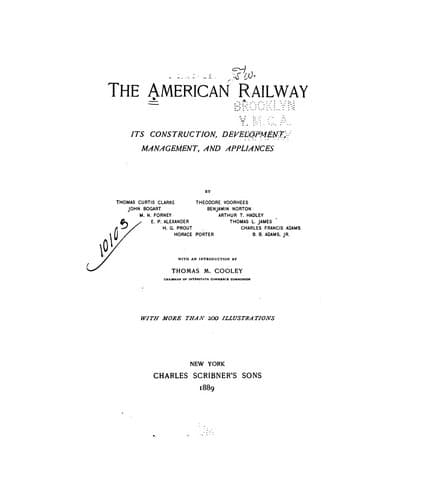
The American Railway: Its Construction, Development, Management, and AppliancesClarke, Thomas Curtis
History
The American Railway: Its Construction, Development, Management, and Appliances
Clarke, Thomas Curtis
Railroads -- United States
At the Centennial Exposition at Philadelphia, in the Post-Office
exhibit, was a double picture showing the postal service at the
beginning of the century and as it is to-day. On one side was a
postman--perhaps Franklin--on horseback, jogging over a corduroy
road, "through the forest primeval," making a mile or two an hour;
and on the other a representation of the fast mail train, the
"catcher" taking a pouch from the "crane" as it passes at the rate
of fifty miles an hour! Standing in the foreground is the pretty
daughter of the village postmaster with the mail pouch just thrown
from the car in her hand, a group of rustics, with ill-concealed
admiration in their eyes, watching her as the swiftly passing train
goes on its journey. This picture is not, perhaps, a work of art,
but it is an "object lesson," giving at a glance the progress that
our country has made in a hundred years.
[Illustration: Postal Progress, 1776-1876.
(Facsimile of a print in the Post-Office Department.)]
Of all the executive departments of the Government, the Post-Office
is the one nearest the people, and the one with which they
are the most familiar. In addition to its work of collecting,
transporting, and delivering legitimate mail matter, viz.,
letters, newspapers, and magazines, it is the greatest express
company of the continent, since it has an office at almost every
cross-roads, even carrying merchandise cheaper (considering the
distance) than its rivals. Its registration system affords a means
of forwarding valuable packages, at a slight additional cost, with
almost absolute security. It is the greatest banking institution
on this side of the Atlantic. The transactions of its money-order
system, not only in our own country, but with almost every nation
in the civilized world (Russia and Spain excepted), run up to
wellnigh fabulous sums. Its drafts are easily obtained and cheap.
Its notes are "gilt edged," and have never been repudiated. With
the creation of the Postal Savings Bank system, the working
people's department in its organization will approach perfection.
The first mention of a travelling post-office occurs in a memorial
addressed to Congress in November, 1776, by Ebenezer Hazard,
Postmaster-General under the Continental Congress, in which he
states that, owing to the frequent removals of the Continental
Army, he was subjected to extraordinary expense, difficulties, and
fatigues, "having paid an exorbitant price for every necessary of
life, and having been obliged, for want of a horse--which could not
be procured--to follow the army on foot."
Public-domain text, read in full here on John Shaqi.
Reviews
Reviews
No reviews yet
Be the first to share your thoughts on this work.
Elsewhere in the archive
Join the Discussion
Join the discussion
Sign in to leave a comment or review.
Sign InorCreate an account