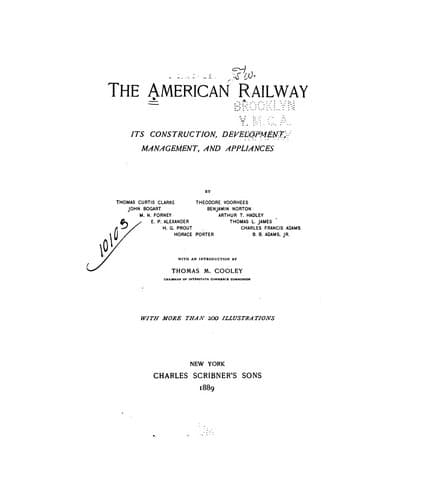
The American Railway: Its Construction, Development, Management, and AppliancesClarke, Thomas Curtis
History
The American Railway: Its Construction, Development, Management, and Appliances
Clarke, Thomas Curtis
Railroads -- United States
This train was a marvel of completeness and efficiency. It was
manned by picked men, and the only complaint ever made against it
was that it ran so fast that the clerks had not time to sort the
mails for the post-offices between New York and Poughkeepsie. To
obviate this, Colonel Bangs requested the postmaster at New York
to have two hundred mail-bags dyed red, which should contain the
mail for those offices nearest together, so that the crew in the
train could distribute them first. There was no complaint after
that. But when the dyer's bill was sent by the postmaster to the
Department, it was disallowed by a clerk of the Second Assistant
Postmaster-General, who, in a letter announcing the fact, said that
there was no necessity for the outlay if the postal clerks did
their duty. Bangs, who had just arrived at the post-office from a
day and night's ride on his favorite train, was lying on a sofa
half asleep in the postmaster's private office, as that official
was opening his mail. When he came to that letter he handed it to
Bangs. He was wide-awake in an instant. "Mr. Postmaster," said he,
"do you know the man who signed this letter? He is a wheezy priest,
a fool, and a Baptist, at that. Give me the letter." The bill was
allowed as soon as Bangs reached the Department. He was wrong,
however, in crediting the subordinate to the Baptist faith. He was
an ornament of another persuasion.
So carefully had the project been considered and adapted that the
service on the Central, from the start, moved with the precision
of clock-work, and was an immediate success. It is proper to say
that word of what was going on between the Department and the
Vanderbilt system reached the Hon. Thomas A. Scott, President of
the Pennsylvania Railroad, and he at once made up his mind that the
corporation under his management could not afford to be behind its
great rival. One Saturday morning he telegraphed to J. D. Layng
(now General Manager of the West Shore and President of the C. C.
C. & I.), then General Manager of the Pennsylvania lines west of
Pittsburg, to know if by the following Monday week, the date on
which the train was to start, four postal cars could be built and
the first one be in Chicago ready to start on its eastern trip.
The answer came back, "Yes." The order was given to the Allegheny
shops on Saturday afternoon, and on the following Saturday the
first of the cars, complete and equipped for mail service, started
for Chicago, and began its east-bound trip on Monday morning.
The second and third cars were finished on Monday night, and the
fourth--thus fully equipping the line--on Tuesday.
Public-domain text, read in full here on John Shaqi.
Reviews
Reviews
No reviews yet
Be the first to share your thoughts on this work.
Elsewhere in the archive
Join the Discussion
Join the discussion
Sign in to leave a comment or review.
Sign InorCreate an account