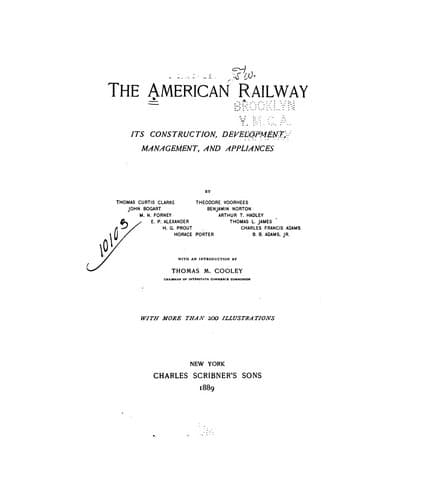
The American Railway: Its Construction, Development, Management, and AppliancesClarke, Thomas Curtis
History
The American Railway: Its Construction, Development, Management, and Appliances
Clarke, Thomas Curtis
Railroads -- United States
would be in no case confined, but extended through all parts of the
country alike."
This report met with the approval of Postmaster-General Jewell,
who ordered Bangs to negotiate with the New York Central & Hudson
River Railroad and the Lake Shore Railroad for a fast mail train,
leaving New York at four o'clock in the morning, and arriving
at Chicago in about twenty-four hours. It was the old story of
making bricks without straw. The Post-Office Department had no
appropriation to pay for such facilities, hence it had to depend at
first on the public spirit of the railroad authorities. Commodore
Vanderbilt, the president of the companies whose lines were to be
used, had had dealings with the Department, and was perhaps not
altogether sanguine as to the practical issue of the experiment,
or in respect to the countenance it would receive from Congress;
but Mr. William H. Vanderbilt, the vice-president, lent a willing
ear to Mr. Bangs's proposition, and did his utmost to aid him
in putting it into effect. There being no special appropriation
available for the purpose in hand, "the devil was whipped around
the stump" by Colonel Bangs stipulating that if Mr. Vanderbilt
would have twenty cars built and the service performed, all matter
originating at or coming into the New York Post-Office, which
could reach its destination at the same time by this line, should
be sent by this train, and that the railway companies could have
the right to demand a weighing of the mail matter at will, all
railroads being paid according to weight. When the details of the
plan were communicated to Commodore Vanderbilt, he is reported to
have said to his son: "If you want to do this, go ahead, but I know
the Post-Office Department, and you will, too, within a year." Mr.
Vanderbilt did "go ahead." He constructed and equipped the finest
mail train ever seen on the planet, ran it for ten months, never
missed a connection at Chicago, and was always on time at New
York. He did not have to wait a year, however, for a realization of
the sagacious old commodore's prophecy. Within three weeks, despite
the indignant protest of Colonel Bangs, the mails of three States
were ordered to be taken from this and given to another route. A
grosser and more wanton breach of plighted faith it would be hard
to find, and its results were far-reaching and disastrous.
Public-domain text, read in full here on John Shaqi.
Reviews
Reviews
No reviews yet
Be the first to share your thoughts on this work.
Elsewhere in the archive
Join the Discussion
Join the discussion
Sign in to leave a comment or review.
Sign InorCreate an account