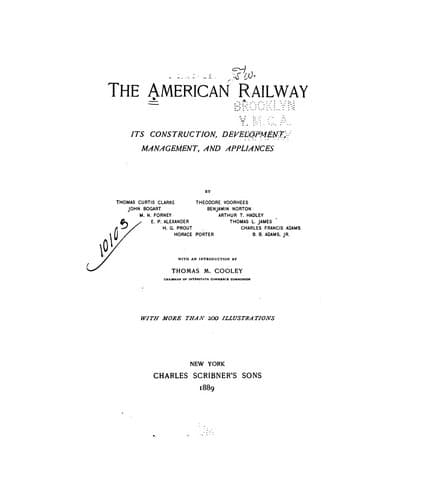
The American Railway: Its Construction, Development, Management, and AppliancesClarke, Thomas Curtis
History
The American Railway: Its Construction, Development, Management, and Appliances
Clarke, Thomas Curtis
Railroads -- United States
There may be more dangerous pursuits in life than that of the
railway post-office clerk, but there are not many so, and there are
few in which the risk to life and limb is so constant. The everyday
citizen who is called upon occasionally to make a railroad journey
of a few hundred miles feels it to be incumbent upon himself on
such occasions to make special provision for those dependent on him
in case injury or death should come while riding in the thoroughly
appointed and luxurious coach placed in a portion of the train
least likely to suffer from accident. But too little thought is
devoted to the safety of those poorly paid but efficient servants
of the State, in the forward cars, without whose services the
business of the country, as conducted to-day, would come to a
stand-still. To show that the importance of this service is not
here exaggerated, it is only necessary to recall the condition
of affairs in New York City, and other cities as well, in March,
1888, when the great blizzard fell upon the land. There were then
no mails for several days, and the prostration which came upon
the community is too well remembered to need comment. The danger
to those within the postal cars, however, is recognized by the
railway people, and efforts have been made in the way of providing
safety appliances, but it is, of course, impossible to lessen the
danger to any great extent. All that American ingenuity suggests
in the way of construction, both inside and outside of the cars,
is provided. The body of the car is most substantially built, the
platforms and couplings are of the most approved patterns, the
trucks are similar to those used under the best passenger coaches,
and the air-brakes and other safety apparatus are all brought into
requisition. Within the cars are saws, axes, hammers, and crowbars
conveniently placed in case of wreck, and safety-bars extend the
length of the cars overhead to which the clerks may cling when
the cars leave the track and roll down embankments, as they often
do. In the year ending June, 1888, there were 248 accidents to
trains upon which postal clerks were employed. In these wrecks four
clerks were killed; sixty-three were seriously, several of the
number permanently, and forty-five slightly injured. The official
report of the accidents shows that the majority of them resulted
from collisions, while others were due to the spreading of the
rails, the failure of air-brakes to work at critical moments, and
obstructions on the track.
In every case where cars were wrecked the postal car was among the
number.
Public-domain text, read in full here on John Shaqi.
Reviews
Reviews
No reviews yet
Be the first to share your thoughts on this work.
Elsewhere in the archive
Join the Discussion
Join the discussion
Sign in to leave a comment or review.
Sign InorCreate an account