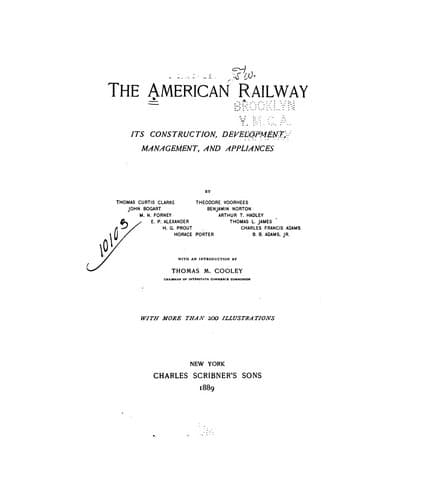
The American Railway: Its Construction, Development, Management, and AppliancesClarke, Thomas Curtis
History
The American Railway: Its Construction, Development, Management, and Appliances
Clarke, Thomas Curtis
Railroads -- United States
The first great need of the Railway Mail Service is an adequate
appropriation by Congress to extend its usefulness, and to keep
it up to the demands and the needs of the public. Where speed
is required to make connections, the Department should have the
cash on hand to buy what is necessary. The railways are business
institutions, managed as such, and when the Department desires
extra facilities it should be prepared to pay in coin and not in
talk. In this connection it is a pleasant duty for the writer of
this very imperfect sketch to say that during his term of service
in the post-office at New York, and at the Department, he always
found Mr. William H. Vanderbilt, Mr. Cornelius Vanderbilt, Mr.
J. H. Rutter, of the New York Central; Mr. John Newell, of the
Lake Shore; Mr. George B. Roberts, Mr. A. J. Cassatt, and Mr.
Frank Thomson, of the Pennsylvania system; Mr. R. R. Bridgers
and Mr. H. B. Plant, of the Atlantic Coast Line, ready to grant
any reasonable request for the improvement and extension of the
service. Time after time Mr. Roberts has run a special train with
the Australian transcontinental mail from Pittsburg to New York,
that it might catch an outgoing steamer; and he and Mr. Vanderbilt
practically re-established the fast mail, by taking letters on
their limited trains. Mr. Roberts gave, in addition, an extra mail
train from Philadelphia west at four o'clock in the morning, and
Mr. Vanderbilt placed a postal car on the 4 P.M. train from New
York, receiving in return--what they had a right to demand--an
extra weighing of the mails, and, what was not a matter of surprise
to them, unmeasured abuse on the floor of Congress for giving these
additional facilities to the people of the country.
The last and greatest need of the postal service is the total
and complete elimination of partisan considerations as affecting
appointments and removals in the working force. The spoils method
invariably brings into the service a lot of do-nothings or a race
of experimenters, whose performances never fail to breed disaster
and to crush out substantial progress.
Public-domain text, read in full here on John Shaqi.
Reviews
Reviews
No reviews yet
Be the first to share your thoughts on this work.
Elsewhere in the archive
Join the Discussion
Join the discussion
Sign in to leave a comment or review.
Sign InorCreate an account