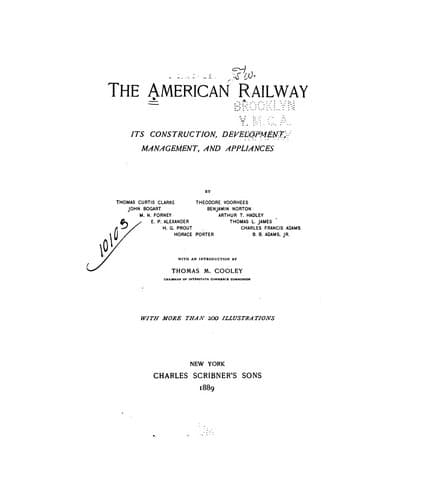
The American Railway: Its Construction, Development, Management, and AppliancesClarke, Thomas Curtis
History
The American Railway: Its Construction, Development, Management, and Appliances
Clarke, Thomas Curtis
Railroads -- United States
At the coming in of Mr. Cleveland's administration, William B.
Thompson was Second Assistant Postmaster-General--in charge of
the contract office--and John Jameson was General Railway Mail
Superintendent. Both of these gentlemen had worked their way from
the ranks by sheer merit. In private business the value of their
services would have been so highly appreciated that, no matter
who became senior partner of the firm, under no circumstances
would they have been permitted to retire. The case of these
gentlemen is mentioned now simply to illustrate an idea and not
to found a complaint. On the incoming of the new administration,
General Thompson, in accordance with precedent, promptly tendered
his resignation, and it was as promptly accepted; while General
Superintendent Jameson struggled along doing his work until,
to relieve his chief from embarrassment, he, too, tendered his
resignation. The country was thus deprived of the services of two
men who were experts in their profession, simply to give place
to others, of high character, no doubt, but with no knowledge
and special aptitude for the great trust that was committed to
them. And now, in the first year of another administration, the
experience that many valuable officials have gained has counted
for nothing, and they have been rotated out. In no other civilized
country would such an atrocity be possible. An attempt to remove,
for similar reasons, such postal authorities as Messrs. Rich, of
Liverpool, Johnston, of Manchester, or Hubson, of Glasgow, all of
whom, under a sound, logical, just, and economical business system,
have reached their present positions by merit and efficiency from
more or less inferior places, would hurl an administration in
Great Britain from power, and justly too. The possession of the
immense patronage of the Government did not save the Republican
party from defeat in 1884, or keep the Democratic party in power in
1888. Ideas are stronger than "soap," and principles more potent
than spoils. It is due to President Cleveland to state that toward
the close of his administration he recognized the importance of
permanency in the Railway Mail Service, and that he made a long
step in advance by approving a series of rules submitted by the
Civil Service Commission having for its object the removal of the
service from the influences of politicians. It needs more than
this, however; it needs the sanctity of the statute law, declaring
that the clerks should not only keep their offices during good
behavior, but that after twenty years of faithful and efficient
service, or before that time, if injured in the discharge of
their duty, they should retire on half-pay. In case of death from
accident while on duty, proper provision should be made for the
family of the official. Whenever justice is done by Congress in
these particulars, the United States will have the best and most
efficient Railway Mail Service in the world.
THE RAILWAY IN ITS BUSINESS RELATIONS.
Public-domain text, read in full here on John Shaqi.
Reviews
Reviews
No reviews yet
Be the first to share your thoughts on this work.
Elsewhere in the archive
Join the Discussion
Join the discussion
Sign in to leave a comment or review.
Sign InorCreate an account