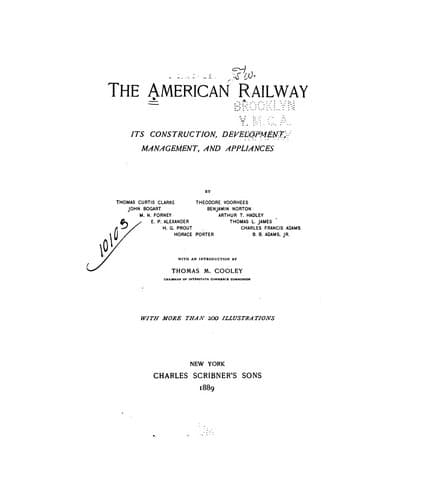
The American Railway: Its Construction, Development, Management, and AppliancesClarke, Thomas Curtis
History
The American Railway: Its Construction, Development, Management, and Appliances
Clarke, Thomas Curtis
Railroads -- United States
BY ARTHUR T. HADLEY.
Amount of Capital Invested in Railways--Important Place in
the Modern Industrial System--The Duke of Bridgewater's
Foresight--The Growth of Half a Century--Early Methods of
Business Management--The Tendency toward Consolidation--How
the War Developed a National Idea--Its Effect on Railroad
Building--Thomson and Scott as Organizers--Vanderbilt's Capacity
for Financial Management--Garrett's Development of the Baltimore
& Ohio--The Concentration of Immense Power in a Few Men--Making
Money out of the Investors--Difficult Positions of Stockholders
and Bondholders--How the Finances are Manipulated by the Board
of Directors--Temptations to the Misuse of Power--Relations of
Railroads to the Public who Use Them--Inequalities in Freight
Rates--Undue Advantages for Large Trade Centres--Proposed
Remedies--Objections to Government Control--Failure of
Grangerism--The Origin of Pools--Their Advantages--Albert
Fink's Great Work--Charles Francis Adams and the Massachusetts
Commission--Adoption of the Interstate Commerce Law--Important
Influence of the Commission--Its Future Functions--Ill-judged
State Legislation.
The railroads of the world are to-day worth from twenty-five to
thirty thousand million dollars. This probably represents one-tenth
of the total wealth of civilized nations, and one-quarter, if not
one-third, of their invested capital. It is doubtful whether the
aggregate plant used in all manufacturing industries can equal it
in value. The capital engaged in banking is but a trifle beside it.
The world's whole stock of money of every kind--gold, silver, and
paper--would purchase only a third of its railroads.
Yet these facts by no means measure the whole importance of the
railroad in the modern industrial system. The business methods
of to-day are in one sense the direct result of improved means
of transportation. The railroad enables the large establishment
to reach the markets of the world with its products; it enables
the large city to receive its food-supplies, if necessary, from
a distance of hundreds or thousands of miles. And while it thus
favors the concentration of capital, it is in itself an extreme
type of this concentration. Almost every distinctive feature of
modern business, whether good or bad, finds in railroad history at
once its chief cause and its fullest development.
[Illustration: George Stephenson.]
Public-domain text, read in full here on John Shaqi.
Reviews
Reviews
No reviews yet
Be the first to share your thoughts on this work.
Elsewhere in the archive
Join the Discussion
Join the discussion
Sign in to leave a comment or review.
Sign InorCreate an account