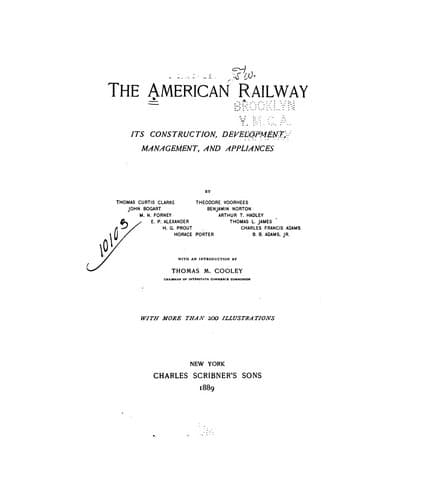
The American Railway: Its Construction, Development, Management, and AppliancesClarke, Thomas Curtis
History
The American Railway: Its Construction, Development, Management, and Appliances
Clarke, Thomas Curtis
Railroads -- United States
From the very first there were some men who felt the importance
of the railroads as national lines of communication. The idea was
present in the minds of the projectors of the Baltimore & Ohio, of
the Erie, and of the Boston & Albany. But it was not until 1850
that it became a controlling one; nor was it universally accepted
even then. As late as 1858 we find that there was a violent popular
agitation in the State of New York to prohibit the New York Central
from carrying freight in competition with the Erie Canal. It was
gravely urged that the railroad had no business to compete with the
canal; that the latter had a natural right to the through traffic
from the West, with which the railroads must not interfere. It is
less than thirty years since a convention at Syracuse, representing
no small part of the public sentiment of New York, formally
recommended "the passage of a law by the next Legislature which
shall confine the railroads of this State to the business for which
they were originally created."
But matters had gone too far for effective action of this kind.
Besides the New York Central, the Erie and the Pennsylvania were in
condition to handle the through traffic which Western connections
were furnishing. These connections themselves were rapidly growing
in importance. Prior to 1850 there were very few railroads west of
the Alleghanies. In 1857 there were thousands of miles. The policy
of land-grants acted as an artificial stimulus to the building of
such roads; and a land-grant road, when once built, was almost
necessarily dependent on through traffic for its support. It
could not be operated locally; it was forced into close traffic
arrangements which paved the way for actual consolidation.
Public-domain text, read in full here on John Shaqi.
Reviews
Reviews
No reviews yet
Be the first to share your thoughts on this work.
Elsewhere in the archive
Join the Discussion
Join the discussion
Sign in to leave a comment or review.
Sign InorCreate an account