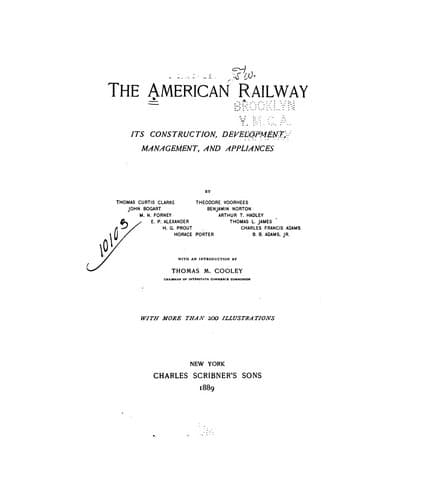
The American Railway: Its Construction, Development, Management, and AppliancesClarke, Thomas Curtis
History
The American Railway: Its Construction, Development, Management, and Appliances
Clarke, Thomas Curtis
Railroads -- United States
There were perhaps a few men who foresaw this growth; there were
almost none who foresaw the changes in organization and business
methods with which it was attended. People at first thought of the
railroad as merely an improved highway, which should charge tolls
like a turnpike or canal, and on which the public should run cars
of its own, independent of the railroad company itself. In many
cases, especially in England, long sheets of tolls were published,
based on the model of canal charters, and naming rates under which
the use of the road-bed should be free to all. This plan soon
proved impracticable. If independent owners tried to run trains
over the same line, it involved a danger of collision and a loss
of economy. The former evil could perhaps be avoided; the latter
could not. The advantages of unity of management were so great that
a road running its own trains could do a much larger business at
lower rates than if ownership and carriage were kept separate. The
old plan was as impracticable as it would be for a manufacturing
company to own the buildings and engines, while each workman owned
the particular piece of machinery which he handled. Almost all the
technical advantages of the new methods would be lost for lack of
system. The railroad company, to serve the public well, could not
remain in the position of a turnpike or canal company, but must
itself do the work of carriage.
This was not all. The same economy which resulted from the union
of road and rolling-stock under one management was still further
subserved by the consolidation of connecting lines. This change
did not come about so suddenly as the other. Half a century had
elapsed before it was fully carried out. At first there was no need
of it. The early railroads were chiefly built for local traffic,
and especially for the carriage of local passengers. They were
like the horse railroads of the present day in the simplicity
of their organization and the shortness of their lines. England
in 1847 had chartered 700 companies, with an average authorized
length of hardly fifteen miles each. The line from Albany to
Buffalo and Niagara Falls was in the hands of a dozen independent
concerns. These were but types of what existed all over the world.
As through traffic, and especially through freight traffic, grew
in importance, this state of things became intolerable. Frequent
transshipment was at once an expense to the railroad and a burden
to the public. Even when this could be avoided, there was a
multiplication of offices and a loss of responsibility. The system
of ownership and management had to adapt itself to the technical
necessities of the business. The change was not the result of
legislation; nor was it, except in a limited sense, the work of men
like Vanderbilt or Scott. It occurred in all parts of the world
at about the same time. It was the result of business necessity,
strong enough to shape legislation, and to find administrative
leaders who could meet its demands.
Public-domain text, read in full here on John Shaqi.
Reviews
Reviews
No reviews yet
Be the first to share your thoughts on this work.
Elsewhere in the archive
Join the Discussion
Join the discussion
Sign in to leave a comment or review.
Sign InorCreate an account