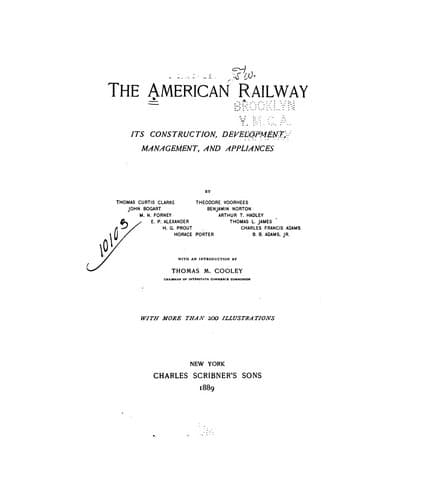
The American Railway: Its Construction, Development, Management, and AppliancesClarke, Thomas Curtis
History
The American Railway: Its Construction, Development, Management, and Appliances
Clarke, Thomas Curtis
Railroads -- United States
In 1847 J. Edgar Thomson, an engineer of experience, entered the
service of the Pennsylvania Railroad, of which he afterward became
president. Three years later, a young man without experience in
railroad business applied to him for a position as clerk in the
station at Duncansville, and was, with some hesitation, accepted.
Not long after--so runs the story--an influential shipper entered
the station, and demanded that some transfers should be made in
a manner contrary to the rules of the company. This the clerk
refused to do; and when the influential shipper tried to attend
to the matter himself, he was forcibly ejected from the premises.
Indignant at this, he complained to the authorities, demanding that
the obnoxious employee be removed from his position. He was--and
was promoted to a much higher one. This is said to have been the
beginning of the railroad career of Thomas Alexander Scott. Edgar
Thomson was a sufficiently able man to appreciate Scott's talent at
its full worth, and took every opportunity to make it useful in the
service of the company. Both before and after the war the system
was extended in every direction; and the man who in 1850 had need
of all his nerve to defy a single influential shipper was a quarter
of a century later at the head of 7,000 miles of the most valuable
railroad in the country.
[Illustration: Thomas A. Scott.]
As an enterprising and active railroad organizer, Scott was
probably unrivalled--especially when aided by the soberer judgment
of Thomson; nor has the operating department of any other railroad
in the country reached the standard established on the Pennsylvania
by Scott and Thomson and the men trained up under their eyes.
But in business sagacity and those qualities which pertain to
the financial management of property, Scott was surpassed by
Vanderbilt. The work of the two men was so totally different in
character that it is hard to compare them. Vanderbilt was not so
distinctively a railroad man as Scott. He had already made his mark
as a ship-owner before he went into railroads. But he was a man
who was bound to take the lead in the business world; and he saw
that the day for doing it with steamships was passing away, and
that the day of railroads was come. He therefore presented his best
steamship to the United States Government in a time when it was
sorely needed, disposed of the others in whatever way he could, and
turned his undivided attention to railroads.
Public-domain text, read in full here on John Shaqi.
Reviews
Reviews
No reviews yet
Be the first to share your thoughts on this work.
Elsewhere in the archive
Join the Discussion
Join the discussion
Sign in to leave a comment or review.
Sign InorCreate an account