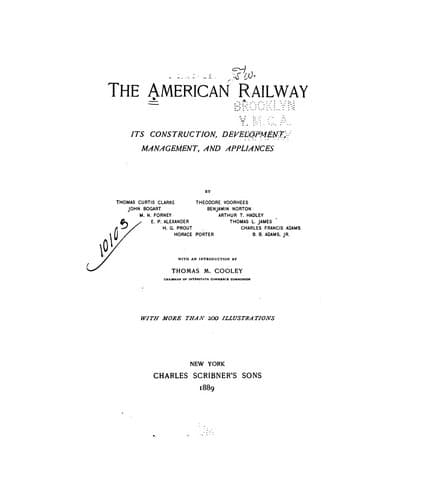
The American Railway: Its Construction, Development, Management, and AppliancesClarke, Thomas Curtis
History
The American Railway: Its Construction, Development, Management, and Appliances
Clarke, Thomas Curtis
Railroads -- United States
In 1863 Vanderbilt began purchasing Harlem stock on a large scale.
The road was unprofitable, but he at once improved its management
and made it pay. Speculators on the other side of the market had
not foreseen the possibility of this course of action, and were
badly deceived in their calculations. Vanderbilt had begun buying
at as low a figure as 3; within little more than a year he had
forced some of its opponents to buy it of him at 285. He soon
extended his operations to Hudson River, and somewhat later to
New York Central. Defeated in an attempt to gain control of Erie,
he turned his attention farther west; and was soon in virtual
possession of a system which, in his hands at any rate, was fully a
match for all competitors.
These systems did not long remain without rivals. The Baltimore
& Ohio, whose development had been interrupted by the war,
soon resumed, under the leadership of John W. Garrett, its old
commanding position in the railroad world. Farther west, in the
years succeeding, systems were developed and consolidated which
surpassed their eastern connections in aggregate mileage. The
combined Wabash and Missouri Pacific system in its best days
included about 10,000 miles of line under what was virtually
a single management. The Southern Pacific, the Atchison, the
Northwestern, and the St. Paul systems control each of them in
one way or another decidedly over 5,000 miles; and a half-dozen
others might be named, scarcely inferior either in magnitude or in
commercial power.
The result of all this was to place an enormous and almost
irresponsible power in the hands of a few men. The directors of
such a system stand for thousands of investors, tens of thousands
of employees, and hundreds of thousands of shippers. They have
the interests of all these parties in their hands for good or
ill. If they are fit men for their places, they will work for the
advantage of all. A man like Vanderbilt gave higher profits, larger
employment, and lower rate as the result of his railroad work. But
if the head of such a system is unfit for his trust intellectually
or morally, the harm which he can do is almost boundless.
[Illustration: Cornelius Vanderbilt.]
Public-domain text, read in full here on John Shaqi.
Reviews
Reviews
No reviews yet
Be the first to share your thoughts on this work.
Elsewhere in the archive
Join the Discussion
Join the discussion
Sign in to leave a comment or review.
Sign InorCreate an account