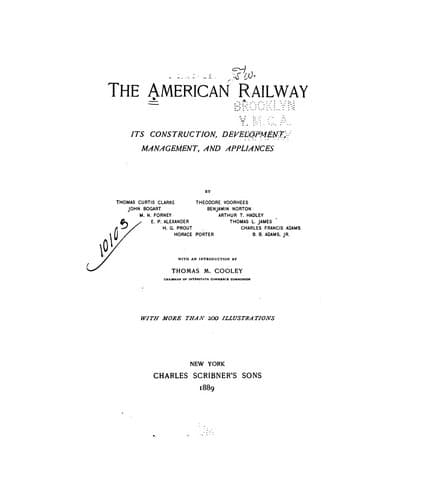
The American Railway: Its Construction, Development, Management, and AppliancesClarke, Thomas Curtis
History
The American Railway: Its Construction, Development, Management, and Appliances
Clarke, Thomas Curtis
Railroads -- United States
The points which got the benefit of the lowest rates were the
large trade centres, which had the benefit of competing lines of
railroad, and often of water competition also. The threat to ship
goods by a rival route was the surest way of making a freight-agent
give low rates. The result was that the growth of such places was
specially stimulated. In addition to their natural advantages they
had an artificial one due to the policy of competing lines of
railroad. It may well be the case, as is argued by railroad men,
that sound railroad economy demands that goods in large masses
should be carried much more cheaply than those which are furnished
in smaller quantities. But it is certain the practice went far
beyond the limits of any such justification. There was a time
when cattle were carried from Chicago to New York at a dollar a
car-load; and many other instances, scarcely less marked, could be
cited from the history of trunk-line competition. The fact was,
that in an active railroad war freight-agents would generally
accede to a demand for reduced rates at a competing point, whether
well founded or not, and would almost always turn a deaf ear to
similar demands from local shippers, however strongly supported by
considerations of far-sighted business policy.
But this was not the worst. Inequalities between different places
might after some hardship correct themselves; differences of
treatment between individuals could not be thus adjusted. And the
system of making rates by special bargain almost always led to
differences between individuals, where favors were too often given
to those who needed or deserved them least. The fluctuation of
rates was first taken advantage of by the unscrupulous speculator.
Often, if he controlled large sources of shipment, he might receive
the benefit of a secret agreement by which he could obtain lower
rates than his rivals under all circumstances. A more effective
means for destroying straightforwardness in business dealings than
the old system of special rates was never devised. Sometimes, where
one competitor was overwhelmingly strong, the pretence of secrecy
was thrown aside, and the railroad companies so far forgot their
public duties as almost openly to assist one concern in crushing
its rivals. The state of things in this respect twelve or fifteen
years ago was so bad that it is painful to dwell upon; but the
reformation to-day is not so complete that we can wash our hands of
past sins.
Public-domain text, read in full here on John Shaqi.
Reviews
Reviews
No reviews yet
Be the first to share your thoughts on this work.
Elsewhere in the archive
Join the Discussion
Join the discussion
Sign in to leave a comment or review.
Sign InorCreate an account