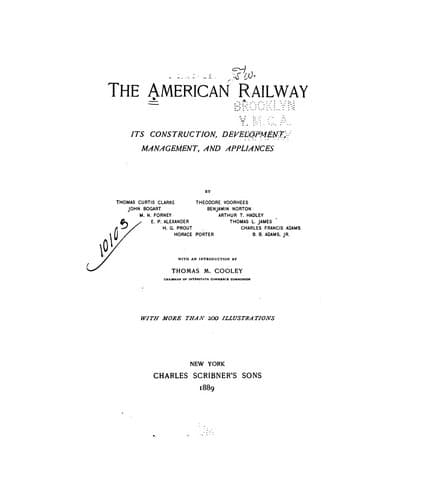
The American Railway: Its Construction, Development, Management, and AppliancesClarke, Thomas Curtis
History
The American Railway: Its Construction, Development, Management, and Appliances
Clarke, Thomas Curtis
Railroads -- United States
Such inequalities existed on a large scale: and they were all the
more difficult to deal with because there was a certain reason
for some of them arising from the nature of railroad business.
The expenses of a railroad are of two kinds. Some, like train and
station service, locomotive fuel, or repairs of rolling-stock, are
pretty directly chargeable to the different parts of the traffic.
It costs a certain amount in wages and in materials to run a
particular train; if that train is taken off, that part of the
expense is saved. But there is another class of items, known as
fixed charges, that do not vary with the amount of business done.
Interest on bonds must be paid, whether the volume of traffic
be large or small. The services of track-watchmen must be paid
for, whether there be a hundred trains daily or only a dozen. In
short, most of the expenses for interest and maintenance of way
are chargeable to the business as a whole, but not to particular
pieces of work done. The practical inference from this is obvious.
In order that the railroad as a whole may be profitable, the fixed
charges must be paid somehow. The railroad manager will try to get
them as he can from different parts of his traffic. But if, for any
reason, a particular piece of business cannot or will not pay its
share of the fixed charges, it is better to secure it at any price
above the bare expense of loading and hauling, without regard to
the fixed charges. For if the business is lost, these charges will
run on just the same, without any added means of meeting them.
The consequence is that there is no natural standard of rates;
or, rather, that there are two standards, so far apart that the
difference between the two is quite sufficient to build up one
establishment or one locality and ruin another, in case of an
arbitrary exercise of power on the part of the freight-agent.
In the use of such a power it was inevitable that there should
be a great many mistakes, and some things which were worse than
mistakes. Colbert once cynically defined taxation as "the art of
so plucking the goose as to secure the largest amount of feathers
with the least amount of squealing." Some of our freight-agents
have taken Colbert's tax theories as a standard, and have applied
them only too literally. It is this short-sighted policy which
has made the system of charging "what the traffic will bear" a
synonyme for extortion. Interpreted rightly, this phrase represents
a sound principle of railroad policy--putting the burden of the
fixed charges on the shipments that can afford to pay them. But
practically--in the popular mind at least--it has come to mean
almost exactly the opposite.
Public-domain text, read in full here on John Shaqi.
Reviews
Reviews
No reviews yet
Be the first to share your thoughts on this work.
Elsewhere in the archive
Join the Discussion
Join the discussion
Sign in to leave a comment or review.
Sign InorCreate an account