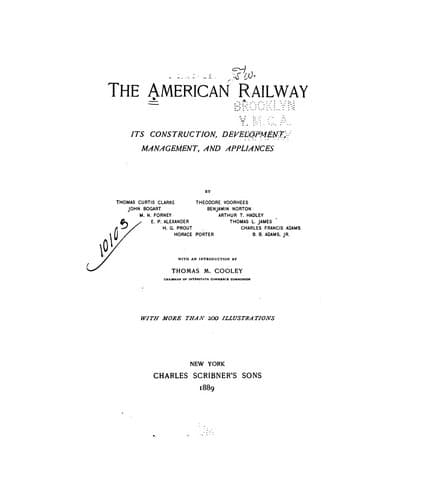
The American Railway: Its Construction, Development, Management, and AppliancesClarke, Thomas Curtis
History
The American Railway: Its Construction, Development, Management, and Appliances
Clarke, Thomas Curtis
Railroads -- United States
Many people assume that, because the government represents the
nation as a whole, therefore government officials will not be
under the same temptations to act unjustly which are felt by the
representatives of a private corporation. This is a mistake. It
is not as representatives of the investor that railroad agents do
much injustice; this motive has practically nothing to do with
it. Most of the abuses complained of are positively injurious to
the investor in the long run. When officials really represent
the interests of the property with wise foresight, they, as a
rule, give the public no ground to complain. The question reduces
itself to this: Will the State choose better representatives and
agents than a private corporation? Will it secure a higher grade
of officials, more competent, more honest, and more enterprising?
The difference between state and private railroads is not so much
on matters of policy as on methods of administration. The success
of government administration varies with different countries. In
Prussia, where it is seen at its best, the results are in some
respects remarkably good; yet even here the roads are not managed
on anything like the American standard of efficiency, either in
amount of train service, in speed, or in rapidity of development.
And what is barely successful in Prussia, with its trained civil
service on the one hand and its less intense industrial demands
on the other, can hardly be considered possible or desirable in
America. No one who has watched the workings of a government
contract can desire to have the whole trade of the country put
to the expense of supporting such methods in its transportation
business.
Public-domain text, read in full here on John Shaqi.
Reviews
Reviews
No reviews yet
Be the first to share your thoughts on this work.
Elsewhere in the archive
Join the Discussion
Join the discussion
Sign in to leave a comment or review.
Sign InorCreate an account