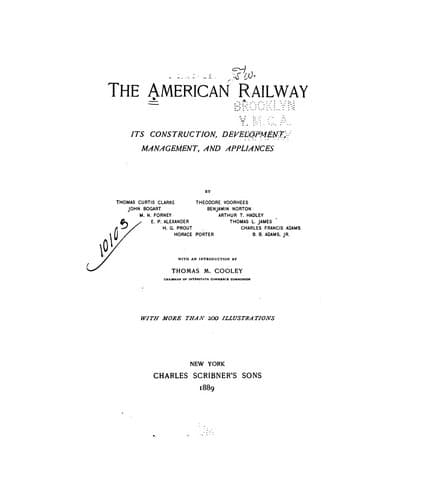
The American Railway: Its Construction, Development, Management, and AppliancesClarke, Thomas Curtis
History
The American Railway: Its Construction, Development, Management, and Appliances
Clarke, Thomas Curtis
Railroads -- United States
A more easy method of trying to regulate railroad charges has been
by forced reductions in rates. This was tried on the largest scale
in the Granger movement fifteen years ago. A fall in the price of
wheat had rendered it difficult for the farmers to make money. The
Patrons of Husbandry, in investigating the causes, saw that the
larger trade centres, where there was competition, were getting
lower rates than the local producer. They reasoned that if all the
farmers could get such low rates, they could make money; and that,
if the roads could afford to make these low rates for any points,
they could afford to do it for all. The railroad agents, instead of
foreseeing the storm and trying to prevent it, assumed a defiant
attitude. The result was that legislatures of the States in the
upper Mississippi Valley passed laws of more or less rigidity,
scaling down all rates to the general level of competitive ones.
After a period of some doubt, the right of the States to do this
was admitted by the courts. But before the legal possibility had
been decided, the practical impossibility of such a course had
been shown. If all rates were reduced to the level of competitive
ones, it left nothing to pay fixed charges. On such terms, foreign
capital would not come into the State; nor could it be enticed by
such a clumsy effort as that of one of the States, which provided
"that no road _hereafter constructed_ shall be subject to the
provisions of this act." The goose which laid the golden eggs was
not such a goose as to be deceived by this. The untimely death of
several of her species meant more than any promises of immunity to
those who should follow in her footsteps. In those States which had
passed the most severe laws capital would not invest; railroads
could not pay interest, their development stopped, and the growth
of the community was seriously checked thereby. The most obnoxious
laws were either repealed or allowed to remain in abeyance. Where
the movement was strongest in 1873 it had practically spent its
force in 1876. There have been many similar attempts in all parts
of the country since that time; just now they are peculiarly
active; but nothing which approaches in recklessness some of the
legislation of 1873 and 1874. The lesson was at least partly
learned.
Public-domain text, read in full here on John Shaqi.
Reviews
Reviews
No reviews yet
Be the first to share your thoughts on this work.
Elsewhere in the archive
Join the Discussion
Join the discussion
Sign in to leave a comment or review.
Sign InorCreate an account