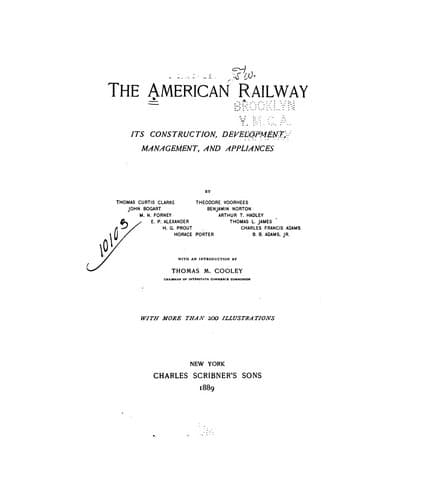
The American Railway: Its Construction, Development, Management, and AppliancesClarke, Thomas Curtis
History
The American Railway: Its Construction, Development, Management, and Appliances
Clarke, Thomas Curtis
Railroads -- United States
But the final test of their success is yet to come. They have laid
down a few principles as to the cases when competition justifies
through rates lower than those at intermediate points. But the
application of these principles is as yet far from settled; and
it is rendered doubly hard by the clause against pools, which
does much to hamper the roads in any attempt to secure common
action on the matter of through rates. Each ill-judged piece of
State legislation, and each reckless attempt to attack railroad
profits, increases the difficulty. There was a time when the
powers of railroad managers were developed without corresponding
responsibility. In many parts of the country we are now going
to the other extreme--increasing the responsibility of railroad
authorities toward shipper and employees, State law and national
commission, and at the same time striving to restrict their powers
to the utmost. Such a policy cannot be continued indefinitely
without a disastrous effect upon railroad service, and, indirectly,
upon the business of the country as a whole.
FOOTNOTES:
[28] In 1886 the capital stock and the indebtedness of the
railroads of the United States amounted to about four thousand
million dollars each. Most of the debt represents money actually
paid in; but a very large fraction of the stock is a merely
nominal liability on which no payments have been made. Some was
issued as here described merely as a means of keeping control of
the property; some, as the easiest method of balancing unequal
values in reorganization; some, to represent increased value of
the property, so as to be able to divide all the current earnings
without calling public attention too prominently to the very
profitable character of the business. On the other hand, some stock
on which money was actually paid has been wiped out of existence;
and something has been paid out of earnings for capital account
without corresponding issue of securities. The net amount of
"water," or excess of nominal liabilities over actual investments,
in the capital account of the railroads of the country can only be
made the subject of guesswork. Estimates of responsible authorities
vary all the way from nothing to $4,000,000,000.
[29] See following article on "The Prevention of Railway Strikes."
[30] See "The Freight-car Service," page 287.
THE PREVENTION OF RAILWAY STRIKES.[31]
BY CHARLES FRANCIS ADAMS.
Public-domain text, read in full here on John Shaqi.
Reviews
Reviews
No reviews yet
Be the first to share your thoughts on this work.
Elsewhere in the archive
Join the Discussion
Join the discussion
Sign in to leave a comment or review.
Sign InorCreate an account