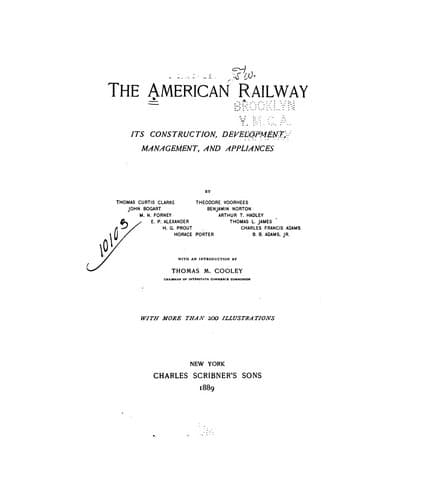
The American Railway: Its Construction, Development, Management, and AppliancesClarke, Thomas Curtis
History
The American Railway: Its Construction, Development, Management, and Appliances
Clarke, Thomas Curtis
Railroads -- United States
was, for the time being, able to interpret it to suit the wishes of
his Congressional district.
The immediate effects of the law were extremely good. There
were certain sections of it, like those which secured publicity
of rates and equal treatment for different persons in the same
circumstances, whose wisdom was universally admitted. Indeed it was
rather a disgrace, both to the railroad agents and to the courts,
that we had to wait for an act of Congress to secure these ends;
and most of the railroads made up for past remissness in this
respect by quite a spasm of virtue. In some instances it was even
thought that they "stood up so straight as to lean over backward."
But this was not the only part of the law which proved efficient.
The very vagueness of the clause concerning the relative rates for
through and local traffic, which under other circumstances might
have proved fatal, put a most salutary power into the hands of the
Interstate Commerce Commission, and one which they were not slow to
use.
[Illustration: Thomas M. Cooley.]
The President was fortunate in his selection of commissioners;
above all in the chairman, Judge T. M. Cooley, of Michigan, a
man whose character, knowledge of public law, and technical
familiarity with railroad business made him singularly well fitted
for the place. The work of the Interstate Commission, like that
of its Massachusetts prototype, shows how much more important is
personal power than mere technical authority. It was supposed at
first that the commission would be a purely administrative body,
with discretion to suspend the law. Instead of this, they have
enforced and interpreted it; and in the process of interpretation
have virtually created a body of additional law, which is read and
quoted as authority. With but little ground for expecting it from
the letter of the act, they have become a judicial body of the
highest importance. Their existence seems to furnish a possibility
for an elastic development of transportation law, neither so weak
as to be ineffective nor so strong as to break by its own rigidity.
Public-domain text, read in full here on John Shaqi.
Reviews
Reviews
No reviews yet
Be the first to share your thoughts on this work.
Elsewhere in the archive
Join the Discussion
Join the discussion
Sign in to leave a comment or review.
Sign InorCreate an account