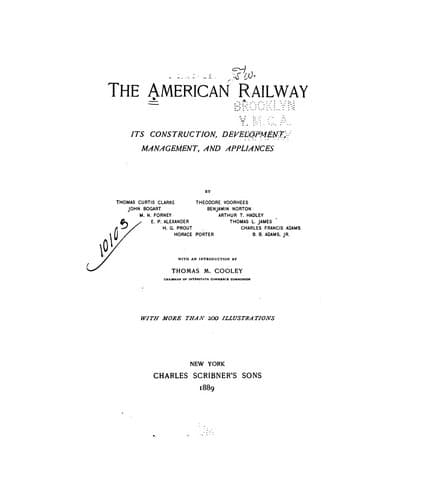
The American Railway: Its Construction, Development, Management, and AppliancesClarke, Thomas Curtis
History
The American Railway: Its Construction, Development, Management, and Appliances
Clarke, Thomas Curtis
Railroads -- United States
The permanent service of a great railroad company should in many
essential respects be very much like a national service, that of
the army or navy, for instance, except in one particular, and a
very important particular: to wit, those in it must of necessity
always be at liberty to resign from it--in other words, to leave
it. The railroad company can hold no one in its employ one moment
against his will. Meanwhile, to belong to the permanent service
of a railroad company of the first class, so far as the employee
is concerned, should mean a great deal. It should carry with it
certain rights and privileges which would cause that service to be
eagerly sought. In the first place, he who had passed through his
period of probation and whose name was enrolled in the permanent
service would naturally feel that his interests were to a large
extent identified with those of the company; and that he on the
other hand had rights and privileges which the company was bound
to respect. It has been a matter of boast in France that every
private soldier in the French army carried the possibility of
the field-marshal's baton in his knapsack. It should be the same
with every employee in the permanent service of a great American
railroad company. The possibility of his rising to any position in
that service for which he showed himself qualified should be open
before him and constantly present in his mind. Many of the most
remarkable and successful men who have handled railroads in the
United States began their active lives as brakemen, as telegraph
operators, even as laborers on the track. Such examples are of
inestimable value. They reveal possibilities open to all.
Beyond this, the man who is permanently enrolled should feel that,
though he may not rise to a high position, yet, as a matter of
right, he is entitled to hold the position to which he has risen
just so long as he demeans himself properly and does his duty well.
He should be free from fear of arbitrary dismissal. In order that
he may have this security, a tribunal should be devised before
which he would have the right to be heard in case charges of
misdemeanor are advanced against him.
Public-domain text, read in full here on John Shaqi.
Reviews
Reviews
No reviews yet
Be the first to share your thoughts on this work.
Elsewhere in the archive
Join the Discussion
Join the discussion
Sign in to leave a comment or review.
Sign InorCreate an account