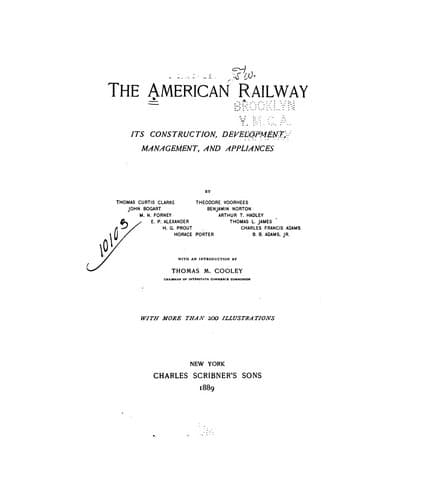
The American Railway: Its Construction, Development, Management, and AppliancesClarke, Thomas Curtis
History
The American Railway: Its Construction, Development, Management, and Appliances
Clarke, Thomas Curtis
Railroads -- United States
No such tribunal has yet been provided in the organization of any
railroad company; neither, as a rule, has the suggestion of such a
tribunal been looked upon with favor either by the official or the
employee. The latter is apt to argue that he already has such a
tribunal in the executive committee of his own labor organization;
and a tribunal, too, upon which he can depend to decide always in
his favor. The official, on the other hand, contends that if he is
to be responsible for results he must have the power of arbitrarily
dismissing the employee. Without it he will not be able to maintain
discipline. The two arguments, besides answering each other, divide
the railroad service into hostile camps. The executive committees
of the labor organizations practically cannot save the members of
those organizations from being got rid of, though they do in many
cases protect them against summary discharge; and, on the other
hand, the official, in the face of the executive committee, enjoys
only in theory the power of summary discharge. The situation is
accordingly false and bad. It provokes hostility. The one party
boasts of a protection which he does not enjoy; the other insists
upon a power which he dares not exercise. The remedy is manifest. A
system should be devised based on recognized facts; a system which
would secure reasonable protection to the employee, and at the
same time enable the official to enforce all necessary discipline.
This a permanent service, with a properly organized tribunal to
appeal to, would bring about. Meanwhile the winnowing process would
be provided for in the temporary service. Over that the official
would have complete control, and the idle, the worthless, and the
insubordinate would be kept off. The wheat would there be separated
from the chaff. Until such a system is devised the existing chaos,
made up of powerless protection and impotent power, must apparently
continue. None the less it is a delusion on the one side and a
mockery on the other.
How the members of such a court as has been suggested would be
appointed and by whom is matter for consideration. It would,
of course, be essential that the appointees should command the
confidence of all in the company's service, whether officials
or employees. The possible means of reaching this result will
presently be discussed.
Public-domain text, read in full here on John Shaqi.
Reviews
Reviews
No reviews yet
Be the first to share your thoughts on this work.
Elsewhere in the archive
Join the Discussion
Join the discussion
Sign in to leave a comment or review.
Sign InorCreate an account