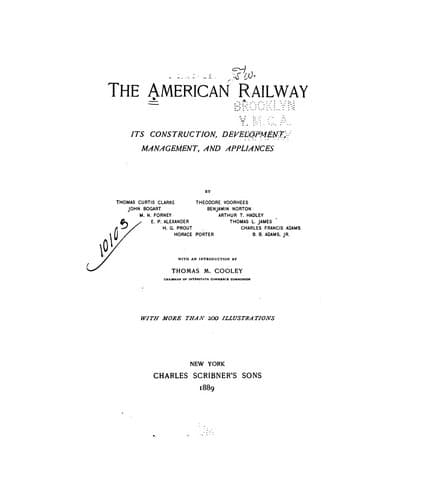
The American Railway: Its Construction, Development, Management, and AppliancesClarke, Thomas Curtis
History
The American Railway: Its Construction, Development, Management, and Appliances
Clarke, Thomas Curtis
Railroads -- United States
There is no reason whatever for supposing that, within the
limits which have been indicated, such an organization would
lead to difficulty. On the contrary, where it did not remove a
difficulty it might readily be made to open a way out of it. The
employees, feeling that they too had rights which the company
frankly recognized and was bound to respect, would in all cases
of agitation proceed through the regular machinery, which brought
them into easy and direct contact with the highest authority in
the company's service. They would not, therefore, be driven into
outside organizations. Meanwhile, on the other hand, the highest
officers of the company, including the president and the board
of directors, would be brought into immediate relations with the
representatives of the employees on terms of equality. Each would
have an equal voice in the management of common interests; and it
would only remain to make provision for arriving at a solution of
questions in case of deadlock. This would naturally be done by the
appointment of a permanent arbitrator, who would be selected in
advance.
The organization suggested includes, it will be remembered, only
those employees whose names are on the permanent rolls of the
operating department. For reasons which have been sufficiently
referred to, those whose names are on the rolls of the other
four departments have not been considered. But there would be
no difficulty in making provision for them also, should it be
found expedient or desirable so to do. Through the system of
representation the organization could in fact be made to include
every employee in the permanent service of the company, not
excepting the president, the general manager, or the general
counsel. Each employee included would have one vote, and each
division and department its representatives. The organization in
other words is elastic. No matter how large it might be it would
never become unwieldy so long as it resulted in the small committee
which met in direct conference face to face with the board of
directors.
Could such a system as that which has been suggested be devised
and put in practical operation there is reason to hope that the
difficulties which have hitherto occurred between the great
railroad companies and those in their pay would not occur in
future. The movement is the natural and necessary outcome of the
vast development referred to in the opening paragraphs of this
paper. It is based on a simple recognition of acknowledged facts,
and follows the lines of action with which the people of this
country are most familiar. The path indicated is that in which for
centuries they have been accustomed to tread. It has led them out
of many difficulties. Why not out of this difficulty?
FOOTNOTES:
Public-domain text, read in full here on John Shaqi.
Reviews
Reviews
No reviews yet
Be the first to share your thoughts on this work.
Elsewhere in the archive
Join the Discussion
Join the discussion
Sign in to leave a comment or review.
Sign InorCreate an account