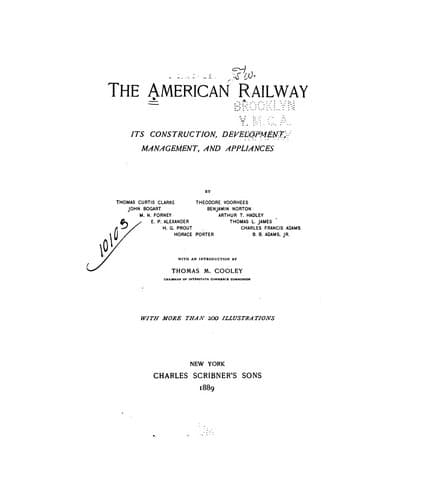
The American Railway: Its Construction, Development, Management, and AppliancesClarke, Thomas Curtis
History
The American Railway: Its Construction, Development, Management, and Appliances
Clarke, Thomas Curtis
Railroads -- United States
It is, of course, impossible to dispose of these difficult matters
in town-meeting. Nevertheless, the town-meeting must be at the base
of any successful plan for disposing of them. The end in view is to
bring the employer--who in this case is the company, represented by
its president and board of directors--and the employees into direct
and immediate contact through a representative system. When thus
brought into direct and immediate contact, the parties must arrive
at results through the usual method: that is, by discussion and
rational agreement. It has already been noticed that the operating
department of a great railroad company naturally subdivides itself
into those concerned in the train movement, those concerned in
the care of the permanent way, and those concerned in the work
of the mechanical department. It would seem proper, therefore,
that a council of employees should be formed, of such a number
as might be agreed on, containing representatives from each of
these departments. In order to make an effective representation,
the council would have to be a large body. For present purposes,
and for the sake of illustration merely, it might be supposed
that, in the case of the Union Pacific, each department in a
division of the road would elect its own members of the employees'
council. There are five of these divisions and three departments
in every division. The operating-men, the yard and section-men,
and the machinists of the division would, therefore, under this
arrangement choose a given number of representatives. If one
such representative was chosen to each hundred employees in the
permanent service those thus selected would constitute a division
council. To perfect the organization, without disturbing the
necessary work of the company, each of these division councils
would then select certain (say, for example, three) of their
number, representing the mechanical, the operating, and the
permanent way departments, and these delegates from each of the
departments would, at certain periods of the year, to be provided
for by the articles of organization, all meet together at the
head-quarters of the company in Omaha. The central council, under
the system here suggested, would consist of fifteen men; that
is, one representing each of the three departments of the five
several divisions. These fifteen men would represent the employees.
It would be for them to select a board of delegates, or small
executive committee, to confer directly with the president and
board of directors. Here would be found the organization through
which the voice of the employees would make itself heard and felt
in matters which directly affect the rights of employees, including
the appointment of a tribunal to pass upon cases of misdemeanor,
and the management of all institutions, whether financial or
educational, to which the employees had contributed and in which
they had a consequent interest.
Public-domain text, read in full here on John Shaqi.
Reviews
Reviews
No reviews yet
Be the first to share your thoughts on this work.
Elsewhere in the archive
Join the Discussion
Join the discussion
Sign in to leave a comment or review.
Sign InorCreate an account