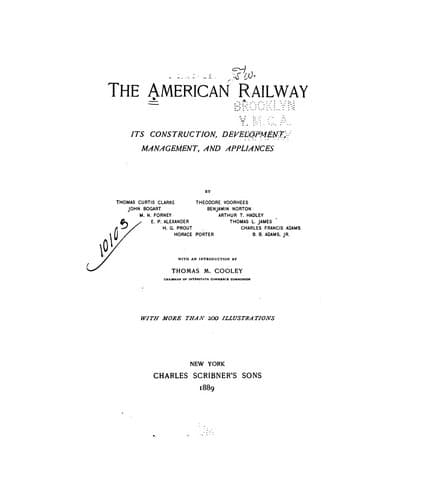
The American Railway: Its Construction, Development, Management, and AppliancesClarke, Thomas Curtis
History
The American Railway: Its Construction, Development, Management, and Appliances
Clarke, Thomas Curtis
Railroads -- United States
Another feature which often involves discomfort, and occasionally
positive suffering and danger, is "going back to flag." When a
train is unexpectedly stopped upon the road, the brakeman at the
rear end must immediately take his red flag or lantern and go back
a half-mile or more to give the "stop" signal to the engine-men of
any train that may be following. This rule is sometimes disregarded
in clear weather on straight lines, and is even evaded by lazy or
unfaithful brakemen where the neglect is positively dangerous,
but still many a faithful man has to go out and stand for a long
time in a severe snow-storm or risk his life in walking several
miles to a station. The record of individual perils and heroisms
in the New York blizzard of March, 1888, are paralleled, or at
least repeated, on a slightly milder scale, by brakemen every
winter. Even in the blizzard country of the Northwest, where a half
hour's exposure is often fatal, the system of train-running is
such that the stopping of a train at an unexpected place involves
danger of collision if the brakeman does not at once go back and
_stay back_. A "tail-end" brakeman has various anxieties, which
cannot be detailed here. Often there is a possibility that the
advancing engineer will not see his red lantern. One brakeman in
New Brunswick several years ago ignominiously deserted his post,
leaving his train to look out for itself, because of a visit from
a huge bear whose residence was in the woods near the point on the
railroad where the brakeman was keeping his lonely night-vigil.
[Illustration: Coupling.]
The danger of sudden accidental death or maiming is constant
and great, and the bare record of the numerous cases is acutely
suggestive of inexpressible suffering; but, strange to say, it does
not worry the average brakeman much. Though probably a thousand
trainmen are killed in this country every year, and four or five
thousand injured, by collisions and derailments, in coupling cars,
falling off trains, striking low overhead bridges, and from other
causes, not one brakeman, from what he sees in his own experience,
realizes the danger very vividly. As in other dangers which are
constant but inevitable, familiarity breeds carelessness which is
closely akin to contempt. Falling from trains is really a serious
danger, because the most ceaseless caution--next to impossible for
the average man to maintain--is necessary to avoid missteps. This
will be practically abolished when the long-wished-for air-brake
comes into use, as that will obviate the necessity of riding on the
tops of the cars.
Public-domain text, read in full here on John Shaqi.
Reviews
Reviews
No reviews yet
Be the first to share your thoughts on this work.
Elsewhere in the archive
Join the Discussion
Join the discussion
Sign in to leave a comment or review.
Sign InorCreate an account