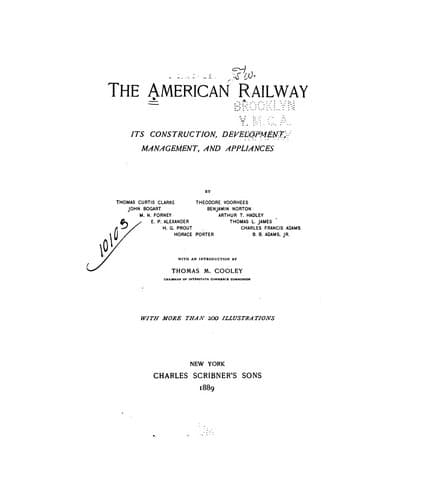
The American Railway: Its Construction, Development, Management, and AppliancesClarke, Thomas Curtis
History
The American Railway: Its Construction, Development, Management, and Appliances
Clarke, Thomas Curtis
Railroads -- United States
Coupling accidents are practically unavoidable because, although
the necessary manipulations _can_ be made without going between
the cars or placing the hands in dangerous situations, the men
as a general thing prefer to take the risk of the more dangerous
method. With the ordinary freight-car apparatus (which, however,
is destined to be superseded by an automatic coupler) the link by
which the cars are connected is retained by a pin in the drawbar of
either car; as one car approaches another at considerable speed,
this link, which hangs loosely down at an angle of thirty degrees,
must be lifted and guided into the opening in the opposite
drawbar. This operation must, according to the regulations of most
roads, be performed by the aid of a short stick; but, disregarding
the regulation, partly to save time and partly because of fear of
the ridicule that would be called out by the exhibition of a lack
of dexterity, the average brakeman uses his fingers. He must lift
the link and hold it horizontally until the end enters the opening,
and then withdraw his hand before the heavy drawbars come together.
A delay of a fraction of a second would crush the hand or finger
as under a trip-hammer. And, in point of fact, this delay does,
for various reasons, frequently happen, and the number of trainmen
with wounded hands to be found in every large freight-yard is sad
evidence of the fact. But again, assuming that this part of the
operation is accomplished in safety, there is another and worse
danger in the possibility of being crushed bodily. Cars are built
with projecting timbers on their ends at or near the centre, for
the purpose of keeping the main body of each car twelve or fifteen
inches from its neighbor; but cars of dissimilar pattern sometimes
meet in such a way that the projections on one lap past those on
the other, and the space which should afford room for the man to
stand in safety is not maintained. If the brakeman, in the darkness
of night or the hurry of his work, fails to note the peculiarities
of the cars, he is mercilessly crushed, the ponderous vehicles
often banging together with a force of many tons. A constant danger
in coupling and uncoupling is the liability to catch the feet in
angles in the track.[33] Freight conductors are peculiarly liable
to this, as the duty of uncoupling (pulling out the coupling-pin)
generally devolves upon them, and must be done while the train is
in motion. Walking rapidly along, in the dark, with the right hand
holding a lantern and grasping the car, while the left is tugging
at a pin which sticks, involves perplexities wherein a moment's
hesitation may prove fatal.
Public-domain text, read in full here on John Shaqi.
Reviews
Reviews
No reviews yet
Be the first to share your thoughts on this work.
Elsewhere in the archive
Join the Discussion
Join the discussion
Sign in to leave a comment or review.
Sign InorCreate an account