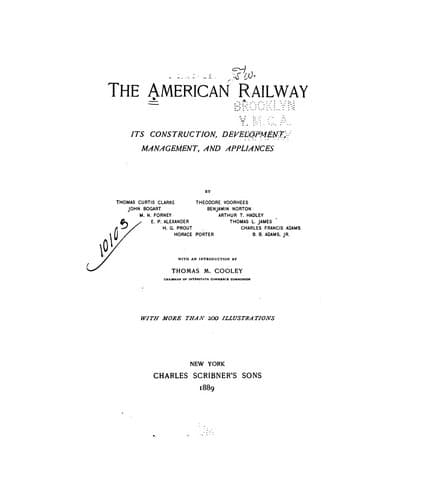
The American Railway: Its Construction, Development, Management, and AppliancesClarke, Thomas Curtis
History
The American Railway: Its Construction, Development, Management, and Appliances
Clarke, Thomas Curtis
Railroads -- United States
On the best of roads a freight train wrecked by a broken wheel
under a borrowed car may be thrown in the path of a passenger train
on another track, just as the latter approaches. This has happened
more than once lately. No amount of fidelity or forethought
(except in the maker of the wheels) can prevent this kind of
disaster. There is constant danger, on most roads, of running off
the track at misplaced switches, many switches being located at
points where the runner can see them only a few seconds before he
is upon them; but the chance is so small--perhaps one in ten or
a hundred thousand--that the average runner forgets it, and it
is only by severe self-discipline that he can hold himself up to
compliance with the rule which requires him to be on the watch for
every switch-target as long before reaching it as he possibly can.
He finds the switches all right and the road perfectly clear so
regularly, day after day and month after month, that he may easily
fall into the snare of thinking that they will always be so. But,
like other trainmen, the engineman finds enough more agreeable
thoughts to fill his mind, and reflects upon the hazards of his
vocation perhaps too little.
[Illustration: Just Time to Jump.]
The freight engineman's every-day thoughts are largely about the
care of his engine and the perplexities incident to getting out
of it the maximum amount of work with the minimum amount of fuel.
The constant aim of his superiors is to have the engine draw every
pound it possibly can. To haul a train up a long and steep grade
when the cars are so heavily loaded that a single additional one
would bring the whole to a dead stand-still requires a knack that
can be appreciated only by viewing the performance on the spot.
Failure not only wastes time and fuel (it may necessitate a return
to the foot of the hill or going to the top with only half the
load), but it raises a suspicion that some other runner might have
succeeded better. The runner whose engine "lays down on the road"
(fails to draw its load because of insufficient fire and consequent
low steam-pressure) is liable to the jeers of his comrades on his
return home, if not to some sharp inquiries from his superior.
Public-domain text, read in full here on John Shaqi.
Reviews
Reviews
No reviews yet
Be the first to share your thoughts on this work.
Elsewhere in the archive
Join the Discussion
Join the discussion
Sign in to leave a comment or review.
Sign InorCreate an account