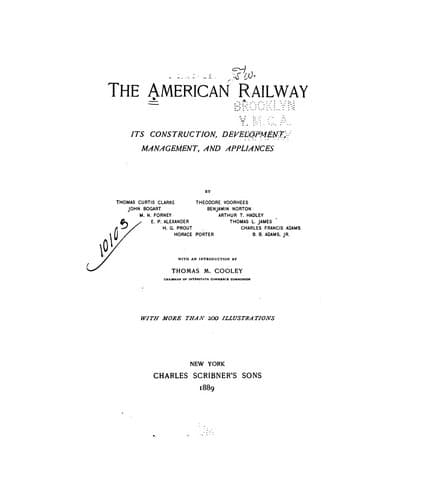
The American Railway: Its Construction, Development, Management, and AppliancesClarke, Thomas Curtis
History
The American Railway: Its Construction, Development, Management, and Appliances
Clarke, Thomas Curtis
Railroads -- United States
The passenger runner's greatest concern is to "make time." Some
trains are scheduled so that the engineman must keep his locomotive
up to its very highest efficiency over every furlong of its
journey in order to arrive at his destination on time. A little
carelessness in firing, in letting cold water into the boiler
irregularly, or in slackening more than is necessary where the
right to the track is in doubt for a few rods; these and a score of
similar circumstances may make five minutes' delay in the arrival
at the terminus and necessitate an embarrassing interview with the
trainmaster. A trip on a crowded line may involve watching for
danger-signals every quarter of a mile and the maintenance of such
high speed that they must be obeyed the instant they are espied in
order to avoid the possibility of collision.[34]
The passenger runner finds himself now and then with a disabled
engine on his hands, and two or three hundred passengers standing
around apparently ready to eat him up if he does not remedy the
difficulty in short order. Often in such cases he is in doubt
himself whether the repairs necessary to enable his engine to
proceed will occupy fifteen minutes or an hour. This, with the
knotty question of where the nearest relief engine is, causes the
brow to knit and the sweat to start, and to the young runner proves
an experience which he long remembers.
[Illustration: A Breakdown on the Road.]
Stories of fast running are common but unreliable; and when
truthful, important considerations are often omitted. There are
so many elements to be considered, that usually the verdict can
be justly rendered only after a careful comparison with previous
records. Most regular runs include a number of stops, and are
subject to numerous slackenings of the speed, thus dimming the
lustre of the record of the trip as a whole. Frequently, quick
runs which have been reported as noteworthy have had favoring
circumstances not told of. The most remarkable single run on
record was that of Jarrett & Palmer's special train chartered to
carry their theatrical company from New York to San Francisco
(Jersey City to Oakland), June 1-4, 1876, which is well known to
all Americans. Perhaps the fastest long run ever made in this
country was that of a special train over the West Shore Railroad
from East Buffalo to Frankfort, N. Y., two hundred and one miles,
on July 9, 1885, which ran this distance in four hours, including
several stops. This train ran thirty-six miles in thirty minutes,
and ran many single miles in forty-three seconds each. An engine
with two cars ran over the Canada Southern Division of the Michigan
Central from St. Clair Junction to Windsor, Ont., on November 16,
1886, a distance of one hundred and seven miles, in ninety-seven
minutes; and this included two or three stops. The average rate
of speed was about sixty-nine miles an hour, and in places it
rose to seventy-five and over. The engineers and their firemen,
Public-domain text, read in full here on John Shaqi.
Reviews
Reviews
No reviews yet
Be the first to share your thoughts on this work.
Elsewhere in the archive
Join the Discussion
Join the discussion
Sign in to leave a comment or review.
Sign InorCreate an account