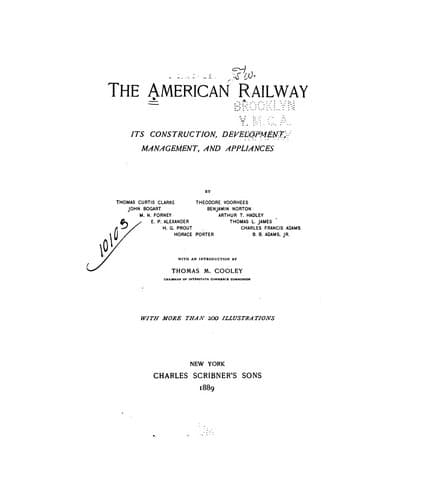
The American Railway: Its Construction, Development, Management, and AppliancesClarke, Thomas Curtis
History
The American Railway: Its Construction, Development, Management, and Appliances
Clarke, Thomas Curtis
Railroads -- United States
The engineer whose humanity is not hardened has his feelings
harrowed occasionally by pedestrians who risk their lives on the
track. Tramps and other careless persons are so numerous that the
casual passenger in a locomotive cab generally cannot ride fifty
miles without seeing what seems to him a hair-breadth escape, but
which is nevertheless treated by the engineer as a commonplace
occurrence. These heedless wayfarers do, however, occasionally
carry their indifference to danger too far, and they are tossed in
the air like feathers.[35] Doubtless there are those who, like the
fireman who talked with the tender-hearted young lady, regret the
killing of a man chiefly "because it musses up the engine so;" but,
taking the fraternity as a whole, warmth of heart and tenderness
of feeling may be called not only well-developed but prominent
traits of character. The great strike on the Chicago, Burlington &
Quincy road in 1888, which proved to have been ill-advised, would
have been possible only in a body of men actuated by the most
loyal friendship. Undoubtedly a large conservative element in the
Brotherhood of Engineers believed the move injudicious, but they
joined in it out of an intense spirit of fidelity to their brethren
and leaders.
* * * * *
[Illustration: The Passenger Conductor.]
The passenger-train conductor has in many respects the most
difficult position in the railroad ranks. He should be a
first-class freight conductor and a polished gentleman to boot. But
in his long apprenticeship on a freight train he has very likely
been learning how _not_ to fulfil the additional requirements of
a passenger conductorship. In that service he could be uncouth
and even boorish, and still fill his position tolerably well; now
he feels the need of a life-time of tuition in dealing with the
diverse phases of human nature met with on a passenger train. He
must now manage his train in a sort of automatic way, for he has
his mind filled with the care of his passengers and the collection
of tickets. He must be good at figures, keeping accounts, and
handling money, though the freight-train service has given him no
experience in this line. Year by year the clerical work connected
with the taking up of tickets and collecting of cash fares has been
increased until now, on many roads, an expert bank clerk would
be none too proficient for the duties imposed. The conductor who
grumblingly averred that "it would take a Philadelphia lawyer with
three heads" to fill his shoes was not far out of the way. Every
day, and perhaps a number of times a day, he must collect fares of
fifty or a hundred persons in less time than he ought to have for
ten. Of that large number a few will generally have a complaint
to make, or an objection to offer, or an impudent assertion
concerning a fault of the railroad company which the conductor
cannot remedy and is not responsible for. A woman will object to
Public-domain text, read in full here on John Shaqi.
Reviews
Reviews
No reviews yet
Be the first to share your thoughts on this work.
Elsewhere in the archive
Join the Discussion
Join the discussion
Sign in to leave a comment or review.
Sign InorCreate an account