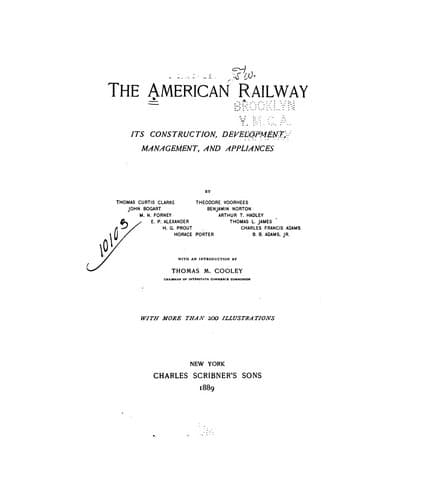
The American Railway: Its Construction, Development, Management, and AppliancesClarke, Thomas Curtis
History
The American Railway: Its Construction, Development, Management, and Appliances
Clarke, Thomas Curtis
Railroads -- United States
paying half-fare for a ten-year-old girl or to paying full rates
for one of fifteen. A person whose income is ten times larger
than he deserves will argue twenty minutes to avoid paying ten
cents more (in cash) than he would have been charged for a ticket.
Passengers with legitimate questions to ask will couch them in
vague and backhanded terms, and those with useless ones will take
inopportune times to propound them. These are not occasional but
every-day experiences. The very best and most intelligent people in
the community (excepting those who travel much) are among those who
oftenest leave their wits at home when they take a railroad trip.
All these people must be met in a conciliatory manner, but without
varying the strict regulations in the least degree. The officers
of the revenue department are inexorable masters, and passengers
offended by alleged uncivil treatment are likely to make absurd
complaints at the superintendent's office. A conductor dreads an
investigation of this sort, however unreasonable the passengers'
complaints may be, because it may tend to show that he lacked tact
in handling the case. But after becoming habituated to this sort of
dealings, there are still left the occasional disturbances which no
amount of philosophy can make pleasant. These are the encounters
with drunken and disorderly passengers. The conductor, starting
at the forward end of his train, finds, perhaps, in the first car
one or two "toughs" who refuse payment of fare and are spoiling
for a fight. Care must be taken with this sort of character not to
punish him or use the least bit of unnecessary severity, for he
will, when sobered off, quite likely be induced by a sharp lawyer
to sue the railroad company for damages by assault. The conductor,
however, if he be one who has (in his freight-train experience)
dealt with tramps, is able to cope with his customer and confine
him to the baggage-car or put him off the train. But a tussle of
this kind is at best far from soothing to the temper, and the very
next car may contain the wife of a nabob, who will expect the most
genteel treatment and critically object to any behavior on the part
of the conductor which is not fully up to the highest drawing-room
standard. Experiences of this kind, it can be readily imagined, are
exceedingly trying. The conductor cannot give himself up completely
to learning gentility, for he still has need for his old severity.
Public-domain text, read in full here on John Shaqi.
Reviews
Reviews
No reviews yet
Be the first to share your thoughts on this work.
Elsewhere in the archive
Join the Discussion
Join the discussion
Sign in to leave a comment or review.
Sign InorCreate an account