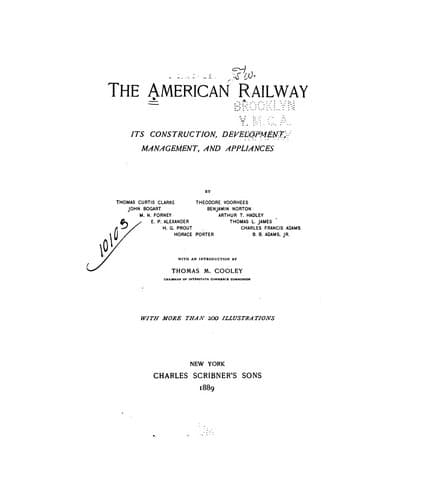
The American Railway: Its Construction, Development, Management, and AppliancesClarke, Thomas Curtis
History
The American Railway: Its Construction, Development, Management, and Appliances
Clarke, Thomas Curtis
Railroads -- United States
One of the habitués of every station is the section-master, who
looks after three, five, or ten miles of track and a gang of from
five to twenty-five men who keep it in repair. He is not much
seen, because he is out on the road most of the time; and his
duties are not of a kind that the reader could study, on paper,
to much advantage; but he deserves mention because his place is
a really important one. Railroad tracks cannot be made, like a
bridge, five times as strong as is necessary, and thus a large
margin be allowed for deterioration; they must be constantly
watched to see that they do not fall even a little below their
highest standard. This care-taking can be intrusted only to one who
has had long experience at the work. In violent rain-storms the
trackman must be on duty night and day and patrol the whole length
of his division to see that gravel is not washed over the track or
out from under it. Though roughly dressed and sunburnt, he is an
important personage in the eye of the engineer of a fast express
train, and if he be the least bit negligent, even to the extent of
letting a few rails get a quarter of an inch lower than they ought
to, he hears a prompt appeal from the engine-runner. The latter
could not feel the confidence necessary to guide his 50-ton giant
over the road at lightning speed with its precious human freight if
he had not a trusty trackman every few miles; and passengers who
feel like expressing gratitude for a safe railroad journey should
never forget this unseen guardian.
A number of classes of men in the railroad service must be turned
off with a word for lack of space. The train despatcher, with
his constant burden of care, deserves a chapter. The locomotive
fireman, who has not been directly alluded to, is practically an
apprentice to the engineer, and, like apprentices in some other
callings, has a good deal of hard work to do. He generally has
longer hours than the engineer, as he has to clean a portion of
the polished brass- and iron-work of the engine. He has to throw
into the fire-box several tons of coal a day, and gets so black
that his best friends would not know him when washed up. Those who
begin young and are intelligent, and conserve their strength, are
at length promoted to be engineers. The fireman's twin brother is
the "hostler," who is employed at the larger termini to get the
iron horse out of its stable, lead it to the watering place and
feed-trough (coal-bin), and harness it to the train.
The clerk in the freight office has almost as much variety of work
as the ticket-seller, and is by no means a mere book-keeper. The
workmen at the freight station are not common laborers. Their work
requires peculiar skill and experience, and they have diversions
worth telling of, if there were space. The men in the shops, and
those who go out with derricks and chains to pick up wrecks, are an
important class by themselves, and bridge-builders, gate-tenders,
and various others bring up the rear.
Public-domain text, read in full here on John Shaqi.
Reviews
Reviews
No reviews yet
Be the first to share your thoughts on this work.
Elsewhere in the archive
Join the Discussion
Join the discussion
Sign in to leave a comment or review.
Sign InorCreate an account