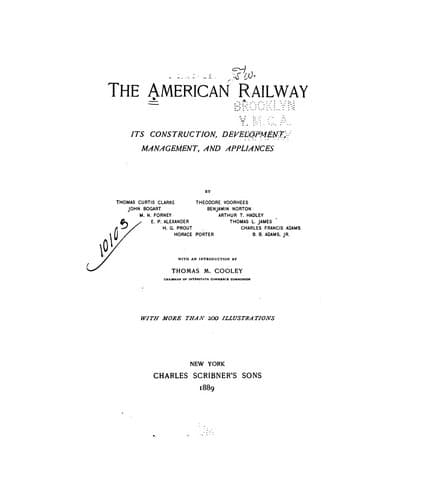
The American Railway: Its Construction, Development, Management, and AppliancesClarke, Thomas Curtis
History
The American Railway: Its Construction, Development, Management, and Appliances
Clarke, Thomas Curtis
Railroads -- United States
* * * * *
The switch-tender, whose momentary carelessness has many a
time caused terrible disaster, but whose constant faithfulness
outweighs a million-fold even that painful record, is one of the
essential figures around a station. Nothing but eternal vigilance
will suffice to keep switches always in safe position, and the
conscientious custodian of these always possible death-traps
often takes his burden of care to his pillow. The mishaps which
do occur strikingly illustrate the practical impossibility of
holding the human brain always to the highest pitch. A conductor
in New Jersey (trainmen have to set switches at many places where
no switchmen are employed) recently caused a slight collision by
misplacing a switch, and on seeing the consequences exclaimed, "I
deserve to be discharged; my mistake was inexcusable." And yet an
honest man of that type is the kind demanded for such a place. The
interlocking of switches and signals (the arrangement in a frame
of the levers moving the switches and those moving signals in such
a way that the signal which tells the engineer to come on _cannot
be given_ until the switch is actually in proper position) is one
of the notable improvements of the last twenty years, and is a
great boon to switchmen, as well as to passengers and the owners
of railroads.[36] By the aid of this apparatus and its distant
signals, connected by wire ropes, the switchman's anxieties are
reduced immeasurably. By concentrating the levers of a number of
switches in a single room one man can do the work of several, and
to the looker-on the perplexities of the position seem to have been
increased instead of diminished. But the switchman's task now is
of a different sort. Under the old plan he was constantly on guard
lest he make a mistake and throw an engine or car off the track.
Under the new, his calculations are chiefly about saving time and
facilitating the work of the trainmen. Questions of danger rarely
come up, being provided against by the perfection of the machinery.
By long familiarity with the ground and the ways of handling the
trains, the switch-tender in an "interlocking tower" is enabled to
safely conduct a score of trains through a labyrinth of switches
in the time that the novice would take to make the first move for
a single train. Without this admirable apparatus, and skilful and
experienced attendants, the business of great stations like the
Grand Central at New York would be impossible in the space allowed.
[Illustration: A Track-walker on a Stormy Night.]
* * * * *
Public-domain text, read in full here on John Shaqi.
Reviews
Reviews
No reviews yet
Be the first to share your thoughts on this work.
Elsewhere in the archive
Join the Discussion
Join the discussion
Sign in to leave a comment or review.
Sign InorCreate an account