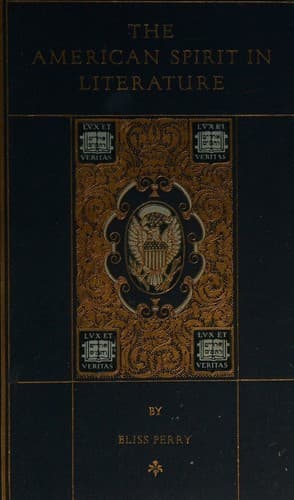
The American Spirit in Literature: A Chronicle of Great InterpretersPerry, Bliss
History
The American Spirit in Literature: A Chronicle of Great Interpreters
Perry, Bliss
American literature -- History and criticism
The gospel or burden of Leaves of Grass is no more difficult of
comprehension than the general drift of Emerson's essays, which helped
to inspire it. The starting-point of the book is a mystical illumination
regarding the unity and blessedness of the universe, an insight passing
understanding, but based upon the revelatory experience of love. In the
light of this experience, all created things are recognized as divine.
The starting-point and center of the Whitman world is the individual
man, the "strong person," imperturbable in mind, athletic in body,
unconquerable, and immortal. Such individuals meet in comradeship, and
pass together along the open roads of the world. No one is excluded
because of his poverty or his sins; there is room in the ideal America
for everybody except the doubter and sceptic. Whitman does not linger
over the smaller groups of human society, like the family. He is not a
fireside poet. He passes directly from his strong persons, meeting
freely on the open road, to his conception of "these States." One of his
typical visions of the breadth and depth and height of America will be
found in By Blue Ontario's Shore. In this and in many similar rhapsodies
Whitman holds obstinately to what may be termed the three points of his
national creed. The first is the newness of America, and its expression
is in his well-known chant of Pioneers, O Pioneers. Yet this new America
is subtly related to the past; and in Whitman's later poems, such as
Passage to India, the spiritual kinship of orient and occident is
emphasized. The second article of the creed is the unity of America.
Here he voices the conceptions of Hamilton, Clay, Webster, and Lincoln.
In spite of all diversity in external aspects the republic is "one and
indivisible." This unity, in Whitman's view, was cemented forever by the
issue of the Civil War. Lincoln, the "Captain," dies indeed on the deck
of the "victor ship," but the ship comes into the harbor "with object
won." Third and finally, Whitman insists upon the solidarity of America
with all countries of the globe. Particularly in his yearning and
thoughtful old age, the poet perceived that humanity has but one heart
and that it should have but one will. No American poet has ever
prophesied so directly and powerfully concerning the final issue
involved in that World War which he did not live to see.
Whitman, like Poe, had defects of character and defects of art. His life
and work raise many problems which will long continue to fascinate and
to baffle the critics. But after all of them have had their say, it will
remain true that he was a seer and a prophet, far in advance of his own
time, like Lincoln, and like Lincoln, an inspired interpreter of the
soul of this republic.
CHAPTER IX.
Union and Liberty
Public-domain text, read in full here on John Shaqi.
Reviews
Reviews
No reviews yet
Be the first to share your thoughts on this work.
Elsewhere in the archive
Join the Discussion
Join the discussion
Sign in to leave a comment or review.
Sign InorCreate an account