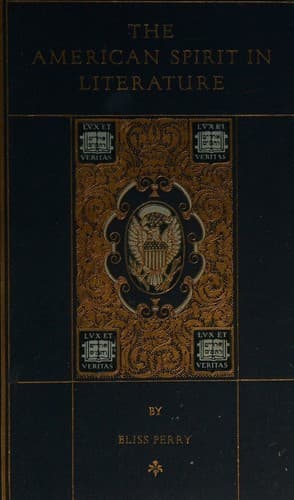
The American Spirit in Literature: A Chronicle of Great InterpretersPerry, Bliss
History
The American Spirit in Literature: A Chronicle of Great Interpreters
Perry, Bliss
American literature -- History and criticism
"There is what I call the American idea," declared Theodore Parker in
the Anti-Slavery Convention of 1850. "This idea demands, as the
proximate organization thereof, a democracy--that is, a government of
all the people, by all the people, for all the people; of course, a
government on the principle of eternal justice, the unchanging law of
God; for shortness' sake, I will call it the idea of Freedom."
These are noble words, and they are thought to have suggested a familiar
phrase of Lincoln's Gettysburg Address, thirteen years later. Yet
students of literature, no less than students of politics, recognize the
difficulty of summarizing in words a national "idea." Precisely what was
the Greek "idea"? What is today the French "idea"? No single formula is
adequate to express such a complex of fact, theories, moods--not even
the famous "Liberty, Fraternity, Equality." The existence of a truly
national life and literature presupposes a certain degree of unity, an
integration of race, language, political institutions, and social
ideals. It is obvious that this problem of national integration meets
peculiar obstacles in the United States. Divergencies of race,
tradition, and social theory, and clashing interests of different
sections have been felt from the beginning of the nation's life. There
was well-nigh complete solidarity in the single province of New England
during a portion of the seventeenth century, and under the leadership of
the great Virginians there was sufficient national fusion to make the
Revolution successful. But early in the nineteenth century, the opening
of the new West, and the increasing economic importance of Slavery as a
peculiar institution of the South, provoked again the ominous question
of the possibility of an enduring Union. From 1820 until the end of the
Civil War, it was the chief political issue of the United States. The
aim of the present chapter is to show how the theme of Union and Liberty
affected our literature.
Public-domain text, read in full here on John Shaqi.
Reviews
Reviews
No reviews yet
Be the first to share your thoughts on this work.
Elsewhere in the archive
Join the Discussion
Join the discussion
Sign in to leave a comment or review.
Sign InorCreate an account